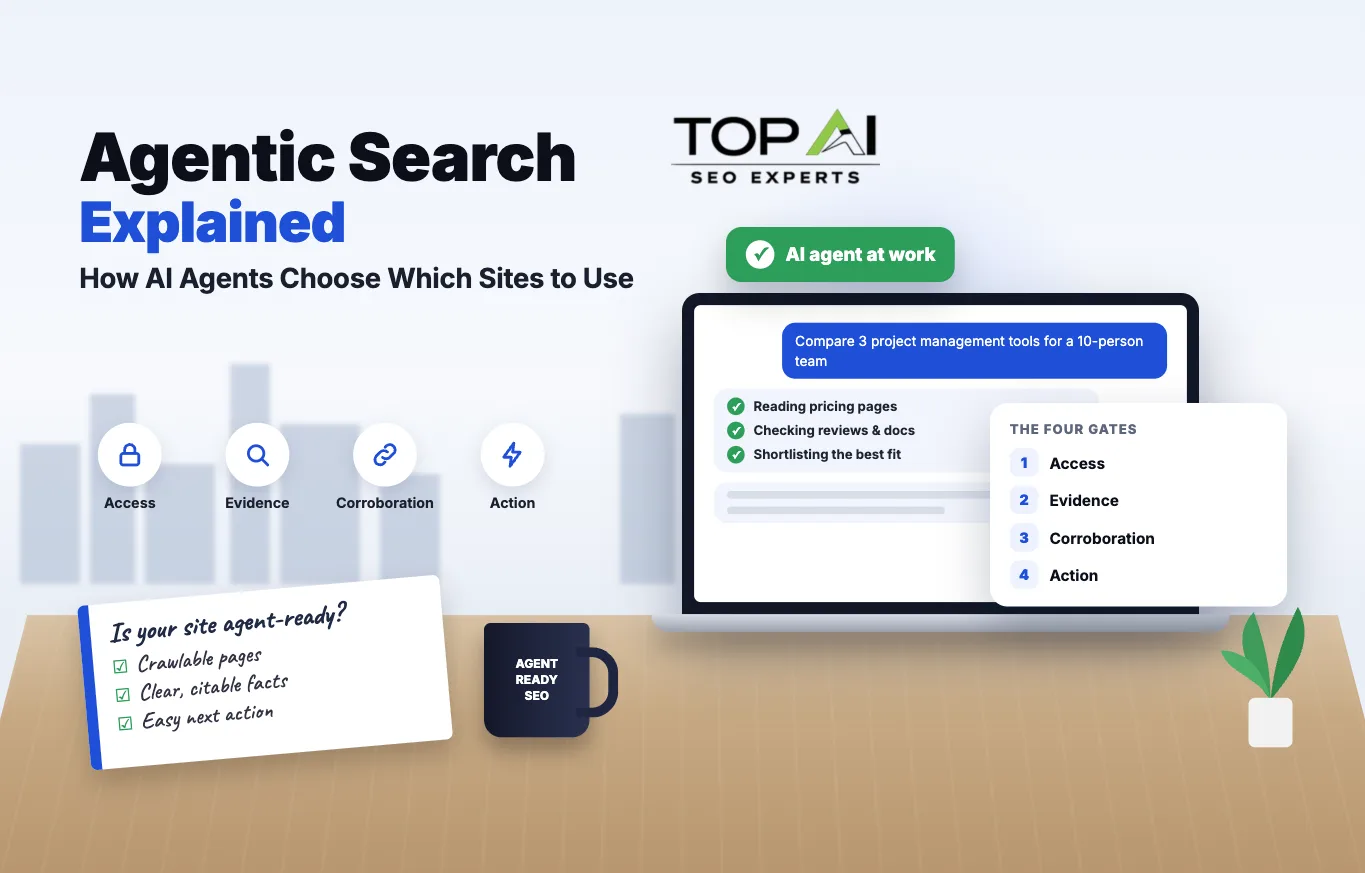
- Agents check four gates. Access, Evidence, Corroboration and Action decide which sites get used.
- Conventional SEO still matters. Agent retrieval often starts from ordinary search results.
- Bot blocking is a decision. Review agent access rules instead of setting them once.
- You can self-check. Server or CDN logs show which agent bots reach your site.
Most of what’s been written about “AI search” so far is really about one moment: the instant a chatbot generates an answer and decides which sources to cite. That’s a real and important problem, and we’ve covered it in our guide to generative engine optimization. But a different, less-discussed shift is happening at the same time. AI agents are no longer just summarizing the web. They’re acting on it: browsing, comparing, filling out forms, and completing tasks on your behalf, autonomously, across multiple sites, in a single session. That’s agentic search, and the rules for getting chosen by an agent mid-task are not the same rules that get you cited in a chat answer.
Agentic search is the process by which an autonomous AI agent plans a multi-step task, decides which web sources to visit and use at each step, and acts on what it finds, rather than returning a single ranked list of links or a one-shot generated answer. The agent might be a research assistant, a shopping assistant, a coding agent pulling documentation, or a browser-automation tool completing a form. What makes it “agentic” is the loop: plan a sub-question, pick a source, read it, decide if that’s enough, and either act or search again. Microsoft’s own description of this pattern in Azure AI Search calls it a “multi-query pipeline” built for exactly this kind of iterative, multi-step retrieval, as opposed to a single query-response call (Microsoft Learn, Azure AI Search documentation).
That loop runs more often, and across more sources, than most site owners assume. A 2026 benchmark of deep research agents from researchers at NYU Shanghai, Yale, and NYU’s Center for Data Science found that different models issued between roughly 7 and 16 web searches per query on average, depending on the model and task type, with some agents returning dozens of reference sources for a single open-ended question (Hu et al., “SAGE: Benchmarking and Improving Retrieval for Deep Research Agents,” arXiv, 2026). Every one of those searches is a fresh decision about which sites get used and which get skipped. If your page only works for the one-shot “get cited in an answer” scenario, you are optimizing for a fraction of the actual exposure available.
Agentic search vs. the search and AI-answer patterns you already know
It helps to place agentic search next to the two patterns most businesses already think about:
| Pattern | What happens | What gets your site “chosen” |
|---|---|---|
| Traditional search | User types a query, gets a ranked list of links, clicks through themselves | Classic ranking signals: relevance, backlinks, on-page SEO, UX |
| AI answer / GEO | User asks a chatbot a question, the model generates one answer and cites a handful of sources | Being extractable, quotable, and consistent enough to be cited in that single generated answer |
| Agentic search | An agent runs a multi-step task, visiting, reading, and sometimes acting on several sites in sequence, without the user watching each step | Being reachable, parseable, verifiable, and in some cases actionable at each step of that loop |
The practical difference is this: GEO is about winning one citation slot in one generated answer. Agentic search is about surviving repeated, automated evaluation across a task that might touch your pricing page, your documentation, a third-party review of you, and a competitor’s page, all in the same agent run. A page can be excellent for GEO and still get skipped by an agent, for reasons that have nothing to do with how well-written it is.
The four gates agents actually check
After working through how browsing and research agents behave in practice, and cross-referencing that against the technical documentation vendors have published about how their retrieval systems work, the decision process breaks down into four checks, run roughly in order. We call this the Four Gates model. An agent doesn’t need to consciously articulate these as rules; they fall out of how the retrieval and reasoning loop is built. A site that fails an earlier gate usually never gets evaluated on the later ones.

Gate 1: Access
Can the agent actually reach and parse the page? This is pass/fail, and it’s where more sites are eliminated than any other gate. It covers whether your robots.txt blocks known agent user-agents (GPTBot, ClaudeBot, PerplexityBot, Google-Extended, and others), whether the page requires JavaScript rendering an agent’s fetcher can’t execute, whether it sits behind a login or a cookie wall, and whether it returns a soft block (a 200 status code with a “verify you’re human” page instead of content). An increasing number of sites also publish an llms.txt file, a plain-Markdown index of a site’s key pages intended to make content easier for an LLM-based tool to locate and parse, though adoption and actual agent usage of it are still early and uneven.
Gate 2: Evidence
Once a page is reachable, does it contain a direct, extractable answer to the sub-question the agent is running? This rewards pages that state the fact, number, or comparison plainly, near the top of the relevant section, rather than burying it under three paragraphs of scene-setting. Structured data (schema.org markup for Product, FAQPage, HowTo, Article) gives the agent a shortcut to the same information in a machine-readable form, which lowers the cost of using your page over a competitor’s unstructured one.
Gate 3: Corroboration
Does what the page claims agree with what other independent sources say? Agents that are built to verify, rather than just retrieve, will cross-check a claim against a second or third source before trusting it, especially for anything volatile like pricing, availability, or specs. A brand’s own page making a claim that no review site, forum, or comparison article corroborates is weaker evidence to an agent than a modest claim that’s repeated consistently across several independent sources.
Gate 4: Action
If the task requires more than reading, such as checking live availability, applying a discount code, or submitting a form, can the agent actually complete that step? This is the newest and least mature gate. It depends on things like whether pricing is in the HTML (not only rendered from a JavaScript price widget an agent’s fetch call won’t execute), whether forms have clean, labeled fields instead of custom JavaScript widgets, and whether there’s an API or structured feed as an alternative path to the same action.
Most published advice about “AI visibility” stops at gate two. That’s a mistake if any part of your business depends on an agent completing a transaction, not just mentioning your name.
A worked example: an agent comparing project management software
Here’s how that plays out on an actual task. Say a user asks an AI agent: “Find a project management tool for a 10-person marketing agency, under $15 per seat, and tell me which one has the best client-facing reporting.” The agent breaks this into sub-questions (pricing at that seat count, feature comparison for client reporting, maybe review sentiment) and starts working through candidate sources.
| Candidate source | Gate 1: Access | Gate 2: Evidence | Gate 3: Corroboration | Outcome |
|---|---|---|---|---|
| Vendor A pricing page | Pass, static HTML | Pass, price table in plain HTML with per-seat tiers | Confirmed by two review sites | Used, cited directly |
| Vendor B pricing page | Fail, prices render only after a JS calculator loads | Not reached | Not reached | Skipped entirely |
| Vendor C comparison blog (third party) | Pass | Pass, has a comparison table | Pricing is 8 months stale and conflicts with Vendor A’s own page | Used for feature context only, pricing claim discarded |
| Vendor D review on a software directory | Pass | Partial, mentions “client reporting” with no specifics | Three other reviews independently mention the same reporting feature | Used as corroborating evidence, not primary |
| Vendor A’s own “client reporting” feature page | Pass | Pass, has a screenshot description and a feature list | No independent confirmation found in the time budget | Used but flagged internally as single-source |
Vendor A wins this task not because its marketing copy is more persuasive, but because its pricing page passed every gate the agent checked and Vendor B’s didn’t get past the first one. That’s the core, uncomfortable lesson of agentic search: an agent will frequently reward the site that’s merely accessible and verifiable over the one that’s better written but harder to parse or confirm.
Want this done for your site?
Get a free AI SEO audit and see exactly where your visibility stands in Google and AI search.
What this changes about SEO priorities
None of this replaces conventional SEO. Relevance, authority, and technical health still matter, because an agent’s underlying retrieval step frequently still runs through a search index before the agent evaluates what it got back. What changes is where the marginal effort should go once those basics are in place. A few shifts we’d actually prioritize differently for agentic search specifically:
Audit your bot access deliberately, not by accident
Check your robots.txt against the current list of major AI crawler user-agents and decide, on purpose, which ones you want in. Blocking them by default (which some security plugins and CDNs do) silently removes you from Gate 1 for every agent that respects robots.txt, per the robots exclusion standard (IETF RFC 9309).
Put the critical facts in server-rendered HTML
If your price, availability, or spec only appears after a client-side script runs, test whether a basic fetch (not a full browser) can still see it. Many agent tool-calls use lightweight fetchers rather than full headless browsers, for cost and speed reasons.
Make your schema markup earn its keep
Product, FAQPage, and Article schema isn’t just for rich snippets anymore; it’s a lower-cost evidence path for an agent evaluating Gate 2. Keep it in sync with the visible page content; a mismatch between schema and on-page text is itself a corroboration failure. This is the same structured-data discipline we build into client sites through our answer engine optimization services.
Get corroborated in places you don’t control
Since Gate 3 rewards claims that show up consistently in independent sources, review sites, comparison articles, and community discussion of your product are not just brand-awareness plays anymore. They’re part of your agentic search infrastructure.
Treat your forms and checkout flow as a technical SEO surface
If you want agents to complete actions on your site, clean, labeled, non-JavaScript-dependent form fields and a documented API or structured feed are now part of that conversation, not just a developer-experience nicety.
Common mistakes and real trade-offs
A few patterns come up often enough to call out directly. The first is treating agent bot-blocking as a security decision made once and forgotten; it’s worth revisiting quarterly as new agent user-agents appear and your security tooling’s defaults change. The second is assuming that because a page ranks well in Google, it’s automatically agent-accessible; ranking and parseability are correlated but not the same thing, and a heavily JavaScript-rendered page can rank fine while still failing Gate 1 for a lightweight agent fetcher.
There’s a real trade-off here, too, and it’s worth saying plainly rather than glossing over: opening your site fully to every AI agent also means competitors’ monitoring agents, aggressive scraping agents, and agents acting for price-comparison tools get the same access. Some businesses reasonably choose to allow research and shopping agents while blocking scraping-oriented bots, which means your robots.txt and bot-management rules need to be more deliberately segmented than a blanket allow or block. There’s no universally correct answer; it depends on how much of your value comes from being found versus how much comes from controlling access to your content.
If you want a structured way to work through where your own site currently stands against these four gates, that’s exactly the kind of audit we do for clients, and you’re welcome to get a free AI SEO audit rather than guess.
How to check where your own site stands
You can get a rough read on your own Gate 1 and Gate 2 status without specialized tools. Start by checking your server logs or CDN logs for requests from GPTBot, ClaudeBot, PerplexityBot, Google-Extended, and Amazonbot, and see what response codes they’re getting; a pattern of 403s or redirect loops tells you a lot. Next, fetch your own key pages with a plain HTTP request (curl, or any tool that doesn’t execute JavaScript) and compare what comes back to what a browser shows you; any critical fact that’s missing from the raw response is invisible to a lightweight agent fetch. Finally, search for your own product or service name alongside a specific, checkable fact (a price, a feature, a policy) and see whether independent sources state it the same way your own site does. Where they disagree, that’s a Gate 3 problem worth fixing on your side first, since you can’t control the third-party pages directly.
This complements, rather than replaces, the citation-focused side of AI visibility we cover in our guide to ranking in Google AI Overviews and our breakdown of what LLM SEO actually means. Citation in a generated answer and survival through an agent’s multi-step task are related problems with overlapping fixes, but they are not the same problem, and treating them as identical is how businesses end up optimized for one and invisible in the other. If your own team doesn’t have the time to run this gate-by-gate, our LLM SEO services cover exactly this kind of technical accessibility work.
Frequently asked questions
01Is agentic search the same thing as AI Overviews or ChatGPT search?
No. AI Overviews and a chatbot’s direct answer are typically single-pass: the system retrieves some sources and generates one response. Agentic search describes a multi-step loop where an agent plans, searches, reads, and often re-searches or acts, across a task that can involve several rounds of source selection before it produces a final result or completes an action.
02Do I need to let AI bots crawl my site?
That’s a business decision, not a purely technical one. Allowing agent crawlers increases your odds of being used in agentic tasks and AI-generated answers, but it also exposes your content to automated analysis by competitors and aggregators. Many sites choose to allow research-oriented agents while blocking bulk-scraping bots, which requires more granular robots.txt rules than a single allow-all or block-all line.
03Does having an llms.txt file guarantee agents will use my site?
No. An llms.txt file is a proposed convention for pointing an LLM-based tool to a site’s key pages in a simple, Markdown-readable format. It can make a site easier to parse for tools that choose to read it, but adoption among agent builders is still inconsistent, and it does nothing to fix a page that’s blocked, JavaScript-only, or factually inconsistent with other sources. Treat it as a minor helper, not a substitute for the four gates above.
04Can small businesses realistically compete for agentic search visibility?
In some ways more easily than they compete in traditional SEO. The gates reward technical accessibility and factual consistency, not domain age or backlink volume. A small, fast, server-rendered site with clear pricing and consistent third-party reviews can pass all four gates more reliably than a large, JavaScript-heavy enterprise site with inconsistent information across its own pages.
05How do I measure whether this work is paying off?
Server and CDN log analysis of known agent user-agents is the most direct signal available today: track their request volume, which pages they hit, and what response codes they get over time. Referral traffic from agent-driven sessions is still thin and inconsistently tagged across tools as of 2026, so log-level monitoring is currently more reliable than referral analytics for this specific question. We go deeper on measurement approaches generally in how to measure AI SEO success.
Agentic search is still early, and the specific tools and conventions (llms.txt, agent-readable schema, standardized action protocols) will keep shifting over the next year or two. The underlying logic probably won’t: agents will keep rewarding sites that are easy to reach, easy to verify, and honest about what they offer, over sites that are merely persuasive. If you want help running this audit against your own site rather than doing it by hand, book a free consultation and we’ll walk through where you stand.