
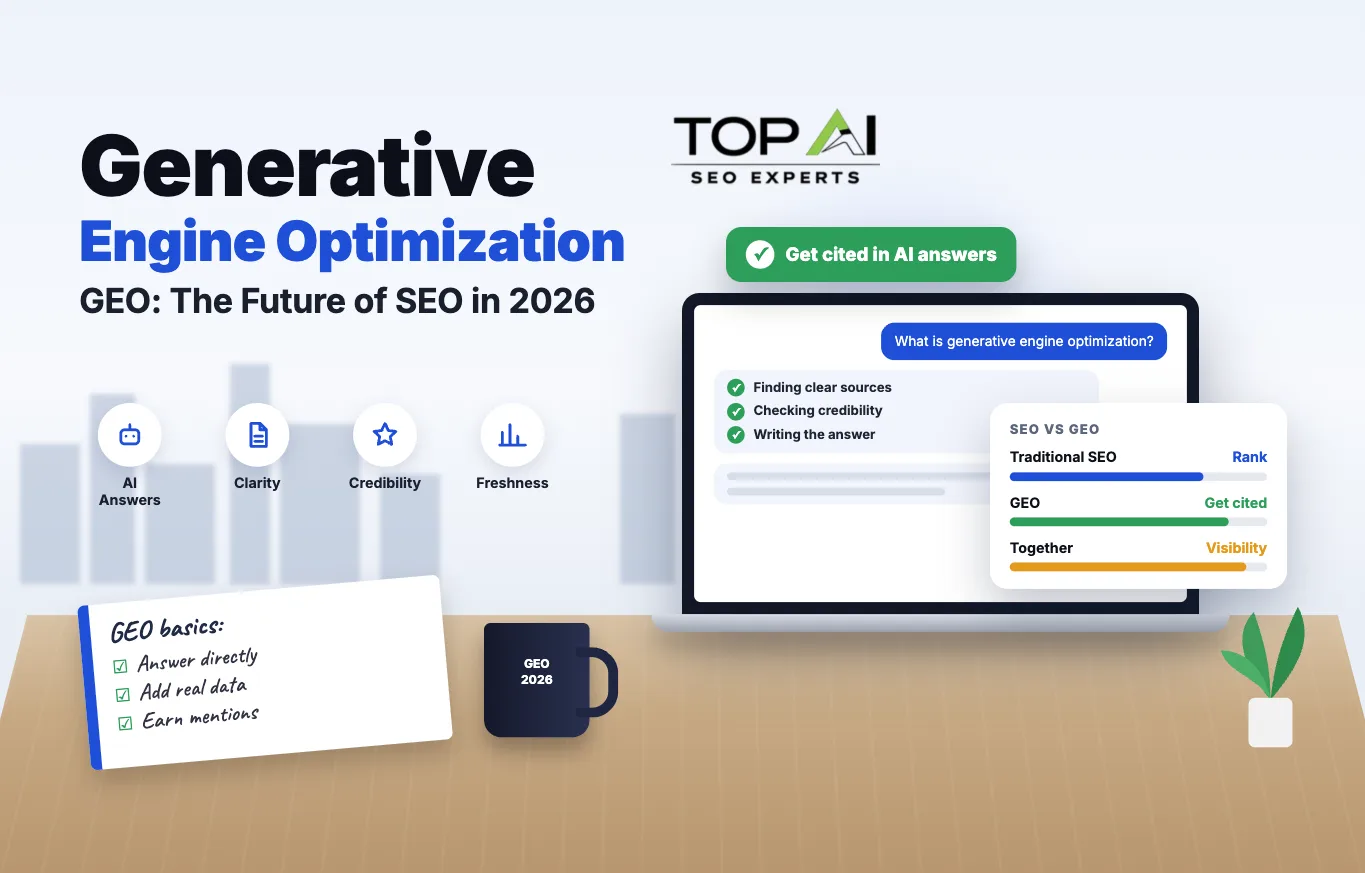
- GEO means being cited. It optimizes content to appear inside AI-generated answers.
- Different goals than SEO. Tactics and metrics change, though SEO foundations still matter.
- AI cites differently. Generative engines judge clarity, credibility and freshness, not just PageRank.
- Five areas move the needle. The practical steps show where to focus first.
If you’ve noticed your organic traffic quietly dropping even though your rankings haven’t changed much, you’re not imagining it – something shifted, and it didn’t happen overnight.
The rise of AI-powered search has introduced a completely new type of competition. ChatGPT, Google’s AI Overviews, Perplexity, and Microsoft Copilot are now answering user questions directly – pulling from web content, synthesizing it, and presenting a confident summary instead of a list of links. Many users never click through at all.
This is why Generative Engine Optimization (GEO) is becoming one of the most important concepts in digital marketing right now. It’s not replacing traditional SEO completely, but ignoring it in 2026 is genuinely risky. Businesses investing in AI SEO services are already ahead of this curve.
What Exactly Is Generative Engine Optimization?
Generative Engine Optimization is the practice of optimizing your content so it gets cited, referenced, or included in AI-generated responses – not just ranked in traditional search results.
Where conventional SEO asks,
“How do I rank on page one of Google?”– GEO asks a different question:
“How do I become the source an AI answers with?”That’s a major difference. AI search engines don’t display ten blue links. They generate paragraphs, pull them from sources they’ve deemed credible and relevant, and often attribute those sources at the bottom. If your content isn’t structured and positioned to be that source, someone else’s will be.
GEO vs SEO: What’s Actually Different?
This isn’t an either/or situation – traditional SEO still matters and Google’s blue links still drive traffic. But the goals, tactics, and success metrics are different enough that treating them as the same discipline will hold you back.
| Factor | Traditional SEO | Generative Engine Optimization |
|---|---|---|
| Primary goal | Rank high in search results | Get cited in AI-generated answers |
| Success metric | Organic clicks, SERP position | Citations, brand mentions, AI visibility |
| Content style | Keyword-rich, structured for crawlers | Authoritative, conversational, fact-dense |
| Backlinks | High importance | Moderate – credibility signals matter more |
| Schema / markup | Helpful | More important – AI reads structured data |
| Speed of results | 3–6 months typically | Still emerging, but authority builds fast |
| Who it affects | All websites | Especially informational / content-heavy sites |
How AI Search Engines Actually Decide What to Cite
Generative AI does not rank content like Google does. They’re not sorted by PageRank or domain authority directly. Instead, they assess content based on a few overlapping factors:
| Factor | What It Means for Your Content |
|---|---|
| Factual Density & Specificity | Vague, fluffy content gets ignored. AI systems prefer content with reliable facts, data points, clear definitions, and original perspectives. |
| Trustworthiness Signals | Author credentials, citations from reputable sources, HTTPS, and consistent publishing history all matter. This overlaps significantly with E-E-A-T. If you’ve already been doing solid topical authority SEO, you’re closer to GEO-ready than you think. |
| Structured, Readable Formatting | AI algorithms understand content better when it has headings, bullet points, and FAQs. Content written in dense blocks is harder to process, and therefore less likely to be used. |
| Brand Mentions Across the Web | If other credible sources talk about your brand or content without necessarily linking to it, AI systems pick that up. Unlinked brand citations have become genuinely valuable – something that barely mattered three years ago. |
How to Rank in AI Search Results: Practical Steps for 2026
Here’s what actually moves the needle. Whether you’re handling this in-house or Consulting with AI SEO specialist, these are the five areas that matter most right now.
1
People on ChatGPT or Perplexity don’t type “GEO SEO 2026” – they ask full questions. Use that in your content and lead with the direct answer upfront, then expand.
2
A genuine stat, a client example, or a perspective that goes beyond the generic consensus can make content citation-worthy. AI tools tend to pull from sources that actually add something new.
3
FAQ, How To, and Article schema help AI systems understand your content structure. If you’re working with a good AI SEO agency, this should already be on their list. Not sure where to start? Get in touch with our team and we’ll walk you through it.
4
Unlinked brand mentions – in guest posts, podcasts, forums, and news pieces – carry real weight with AI systems. They’re building a picture of who’s credible in a space, and backlinks aren’t the only signal they use.
5
Outdated content gets quietly deprioritised. Regular updates, fresh statistics, and current examples tell AI systems your content reflects the world as it is now, not two years ago.
Find Out Your Site’s AI Visibility Score
Start with a free AI SEO audit and get a clear picture of what gaps exist and where to focus first.
GEO Isn’t the Death of SEO – It’s Its Evolution
Traditional search still drives enormous traffic volumes. And the foundations of good SEO – quality content, technical health, strong internal linking, topical depth – are the same foundations that GEO is built on. They’re not competing strategies. They’re layered ones. The best AI SEO companies in India are already building both in parallel for their clients.
What’s changing is the destination. Users are increasingly getting their answers without visiting a website at all. The way to stay relevant isn’t gaming a new algorithm – it’s becoming genuinely authoritative on the topics that matter to your audience.
Frequently Asked Questions
01Is GEO the same as AI SEO?
Not exactly, though they are closely related. AI SEO is a broad term covering the use of AI tools to speed up keyword research and improve content in the traditional SEO process. GEO is more specific – it’s about ensuring your content actually shows up inside AI-generated answers, not just in ranked search results.
02Does GEO require a completely different content strategy?
No. If your content is already high quality and well-structured, you’re in a strong starting position. GEO is mostly an extension of good content practice rather than a full rebuild.
03How do I measure GEO performance?
There’s no single dashboard that tells you AI is citing you – yet. What you can track is brand mentions across the web, whether your content appears in Google AI Overviews, and tools like SE Ranking or Brandwatch that are beginning to measure AI visibility specifically.
04Does GEO only matter for big brands?
Not at all. If anything, smaller brands that move early have a real advantage here. AI systems care far more about content quality and topical authority than brand size. The playing field is more level than it’s ever been.
05Should I stop focusing on Google rankings and shift entirely to GEO?
No. The smarter move is building both in parallel, since the foundations largely overlap. Strong topical authority helps your Google rankings and increases your chances of being cited in AI-generated answers at the same time.