
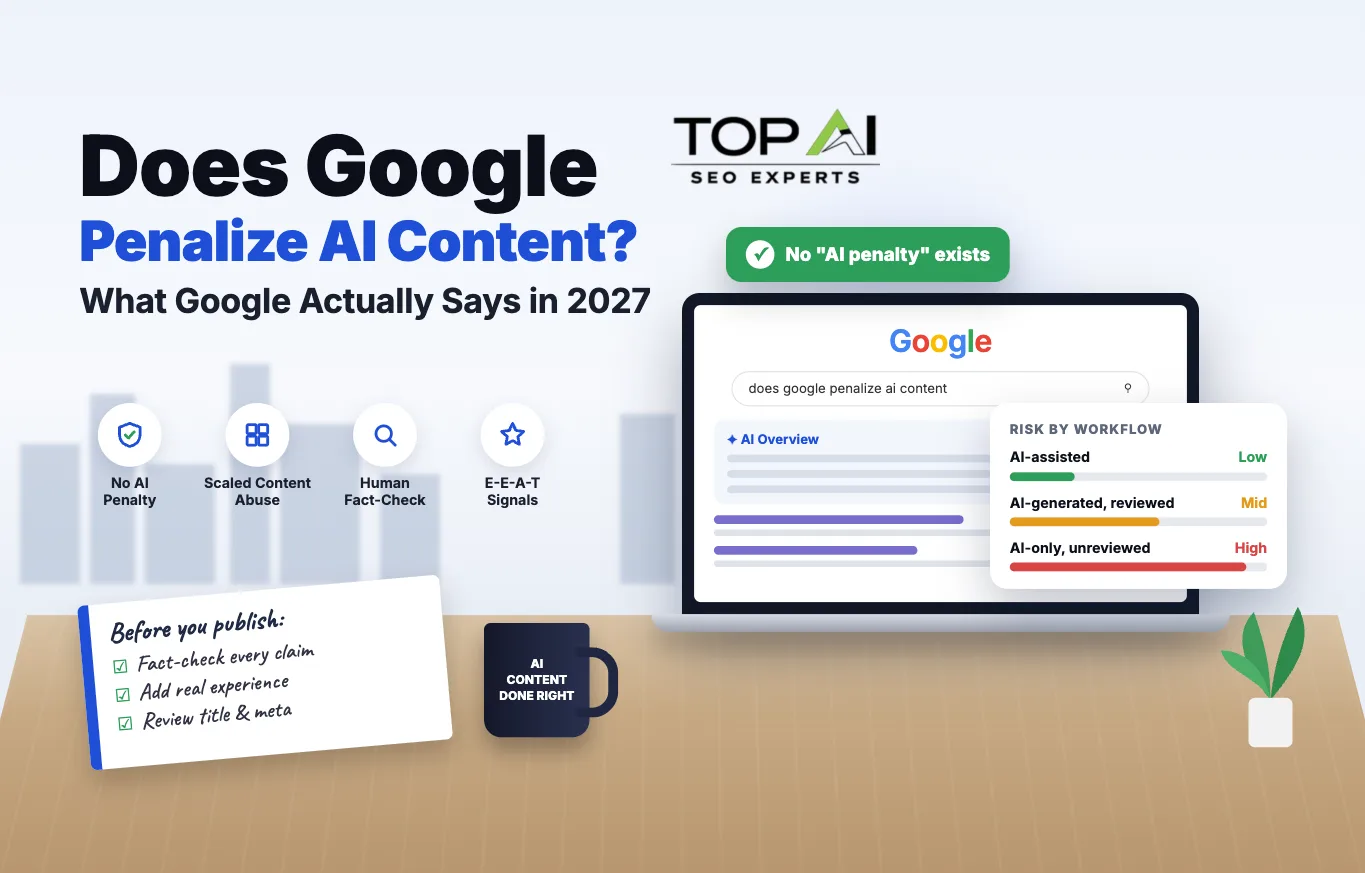
- There is no “AI penalty.” Google judges the page, not the production method.
- Scaled content abuse is the real risk: many low-value pages, no matter how they are created.
- Google requires a human fact-check of AI drafts, including titles, meta descriptions, schema and alt text.
- Experience is the gap. AI has none, so human detail and verified facts decide whether a page earns its place.
No. Google does not penalize content for being written with AI. Its guidance treats AI as a tool that is fine to use, and its spam policy targets something else: pages published at scale with little or no value to readers, no matter how they are created. What gets sites into trouble today is the same thing that got content farms into trouble long before generative AI existed.
The real question content teams ask is different: “will my specific workflow get my site into trouble, and how do I tell before I publish 40 posts and find out the hard way?” That is what this guide answers.
What Google’s documentation actually says
Google’s guidance on generative AI content (last updated 1 October 2026) is short and practical. It starts from the position that AI is useful, then sets one firm condition.
“Generative AI can be particularly useful when researching a topic, and to add structure to original content.”
Google Search Central, Using generative AI content“It is critical to manually factcheck and review all AI-generated content for accuracy and trustworthiness before publishing.”
Same page. The review also covers title elements, meta descriptions, structured data and image alt text.Notice what is not there. No line says AI-written pages rank lower, and no rule says you must label AI-assisted content. Google asks for a human review before anything goes live, because language models predict likely wording rather than retrieve verified facts. That is why invented statistics and wrong dates slip through when nobody checks the draft.
The position is not new. Google’s February 2023 Search Central post on AI-generated content set out the same principle: its systems reward helpful, high-quality content however it is produced, and using automation mainly to manipulate rankings is what breaks its policies.
What scaled content abuse actually means
This is the policy that gets blurred into a vague “AI penalty,” so read it precisely. Since the March 2024 core update and spam policy changes, Google’s spam policies define it like this:
“Scaled content abuse is when many pages are generated for the primary purpose of manipulating search rankings and not helping users. This abusive practice is typically focused on creating large amounts of unoriginal content that provides little to no value to users, no matter how it’s created.”
Google Search Essentials, spam policiesPurpose and value, not method
A 2,000-word human article that adds nothing beyond the top five results can fail the same bar as an unedited AI draft.
“Little to no value” does the work
Google’s rater guidelines give the lowest ratings to content made with little effort, originality or added value. Ratings don’t change rankings directly, but they show what Google’s systems aim to reward.
No published volume limit
Google has never said ten pages a day is fine and fifty is not. The honest test: what does a reader get here that the top results don’t already give them?
The clause that matters most is no matter how it’s created. A content farm publishing 500 thin pages a week with freelance writers in 2015 broke the same principle. What generative AI changed is volume: one workflow can now produce in a day what used to take a team a month.
Where the “Google penalizes AI” myth comes from
If the policy is this clear, why does the myth keep spreading? Four real patterns feed it, and each one calls for a different fix.
“Google caught our AI content”
A site jumps from 40,000 to 400,000 words a month, then loses traffic in a core update.
RealityThe volume dragged down average quality, and quality signals did the rest. The AI tool delivered the risk; it wasn’t the risk.
“Detectors prove it’s a ranking factor”
“Studies” run AI detectors on top pages and report how many look human-written.
RealityDetectors estimate writing patterns and can’t verify authorship. Google has never said it uses them in ranking.
“An update wiped out 80% of AI sites”
Dramatic numbers with no link, no named site and no method.
RealityGoogle’s update documentation never names AI authorship as a target. Ask who measured it, across how many sites.
“AI content = low quality”
“AI-generated,” “no human in the loop” and “low quality” get merged into one idea.
RealityThey often appear together but aren’t the same. The gap between them is where a good workflow lives.
E-E-A-T and why unreviewed AI drafts fall short
E-E-A-T stands for Experience, Expertise, Authoritativeness and Trustworthiness. It is not an algorithm you satisfy with a checklist. It is the framework in Google’s rater guidelines for judging whether a page reflects real competence. Google added the first “E,” Experience, in December 2022 to recognise content written by someone who has actually done or used the thing they describe.
An AI model has no first-hand experience. It can write an accurate paragraph about migrating a site to a new CMS, but it has never lost rankings during one. AI-only drafts read generic because they produce the statistically likely sentence, and the likely sentence rarely contains the specific detail that comes from someone who was there. That same specificity is what gets a page cited by AI answer engines, which we cover in what LLM SEO actually means.
A decision framework: three tiers of AI use
Not all AI use carries the same risk. Thinking in three tiers is more useful than a simple “used AI or didn’t.”
AI-assisted
A person researches, outlines and sets the angle. AI helps draft sections. A human edits every sentence, adds real examples and verifies every claim.
AI-generated, reviewed
AI writes most of the draft from a brief. An editor fact-checks and rewrites weak sections but adds no new first-hand material.
AI-only, unreviewed
Prompt in, publish out, no human review, often in batches across many URLs or sites.
Not sure which tier you’re in?
Our free AI SEO audit reviews your content workflow alongside the rest of your site and shows where the risk sits.
A safe review workflow for AI-assisted content
Most teams work in the middle tier. Moving a draft into the low-risk tier comes down to five steps, done in this order, every time.
The publishing checklist
Run this before anything AI-assisted goes live, whether it is one article or fifty.
- A human set the angle. If the only input was a keyword and a word count, expect filler.
- Every fact is checked against a primary source: claims, statistics, dates and names. This is Google’s own requirement.
- The page adds something new: an example, your own data, a counterpoint or a reasoned opinion. If you can’t name it, it isn’t ready.
- Edited line by line, not skimmed. Cut generic transitions and vague “many experts believe” lines.
- Metadata reviewed too: title tag, meta description, structured data and alt text.
- Speed matches review capacity. If editors can vet five articles a week, publishing thirty is the risk, not the AI.
- Automation disclosed where it helps readers, such as an auto-generated data table. A trust signal, not a ranking rule.
- Site-wide quality watched. One weak batch can affect how the whole domain is judged. A topical authority strategy keeps volume focused.
Want to scale content without the risk?
Book a free consultation and we’ll help you design a review workflow that moves fast without tripping scaled content abuse signals.
Frequently asked questions
01Does using ChatGPT or another AI tool to write blog posts violate Google’s guidelines?
No, not by itself. Google’s guidance says AI can be useful for research and structure. What violates its spam policy is generating many pages that add little or no value, however they were produced.
02What is scaled content abuse?
It is a Google spam policy covering many pages created mainly to manipulate rankings rather than help users, typically large amounts of unoriginal content with little value, no matter how it is created.
03Will Google detect that my content was written by AI?
Google has never said it uses AI-detection tools as a ranking signal. Its systems evaluate originality, accuracy, depth and usefulness, which AI-assisted content can pass or fail depending on how much human work goes into it.
04Do I need to disclose that content was AI-assisted?
Not for rankings. Sharing how content was made can help readers trust it in some contexts, but Google does not require a disclosure label.
05How much AI-assisted content can I publish before it becomes risky?
There is no published number. The real gauge is whether your review process keeps pace with your publishing volume. Rubber-stamped drafts are the risk, whatever the weekly count.
06Is AI content bad for E-E-A-T?
Not inherently. AI has no first-hand experience, so AI-only drafts tend to lack the specific detail that signals expertise. Adding genuine experience and verified facts closes most of that gap.