
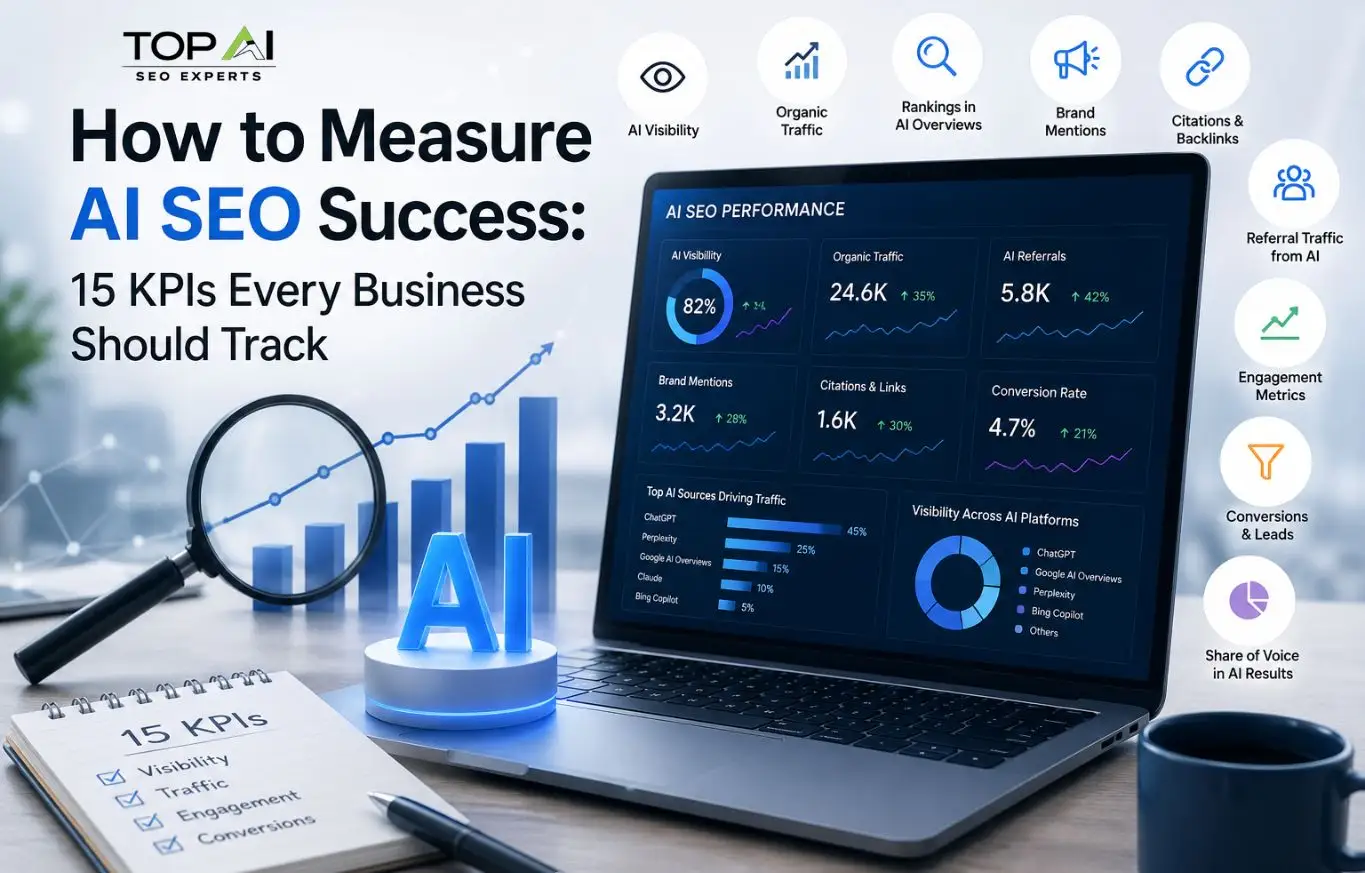
Most "how to measure SEO" articles give you a list of metric names and one sentence per line, which is close to useless. Knowing that "organic traffic" is a metric doesn't tell you how to check it correctly, what a meaningful change actually looks like, or what to do when the number moves. Here's a more honest breakdown of the metrics worth tracking, how to actually pull them, and the mistakes people make reading them.
Visibility metrics
Organic traffic growth. Pull this from Google Search Console (Performance report, filtered to Search type: Web) rather than Google Analytics alone, because GA's channel attribution can misclassify traffic, especially with AI referral sources that don't pass clean referrer data. Compare year over year, not month over month, because search traffic is seasonal for almost every business. A 10% month over month dip in January after a strong November and December is often just the post holiday slowdown, not a problem with your SEO.
Keyword rankings. Track rankings for a defined list of terms you actually care about commercially, not every keyword your site happens to rank for. Separate your tracking into three buckets: terms you already rank page one for (defend these), terms ranking positions 4 to 15 (these are your biggest opportunity, since moving from position 8 to position 3 often has a bigger traffic impact than moving from 25 to 15), and terms you don't rank for yet but competitors do. Checking weekly is usually enough; daily rank checks mostly just show you normal algorithm noise and will make you anxious for no reason.
AI Overview and citation appearances. This is newer and harder to track cleanly because no single tool captures it perfectly yet. The most reliable manual method: pick your 15 to 20 highest value queries, search them yourself (logged out, in an incognito window, since AI Overviews can vary by account history and location), and log whether an AI Overview appears and whether your domain is cited within it. Do this monthly and keep a spreadsheet. It's tedious, but it's more accurate right now than relying on third party tools that estimate this inconsistently.
Traffic quality
Click through rate. Check this in Search Console by query, not just in aggregate. A page ranking position 3 with a 1% CTR usually means your title tag and meta description aren't compelling, even if the ranking itself is fine. Compare your CTR at each position against typical patterns for that position; if you're well below what similar pages usually get, rewrite the title and description before touching anything else on the page.
Bounce rate and engagement time. In GA4, this shows up as engagement rate and average engagement time per session. A high bounce rate isn't automatically bad: someone searching "roofing company phone number" who lands on your contact page, gets the number, and leaves in eight seconds had a completely successful visit. Context matters more than the raw number. Look at this metric per page type, not as one blended site average.
Organic conversion rate. Define what counts as a conversion before you start measuring: a form fill, a phone call tracked through call tracking software, a scheduled estimate, whatever maps to your actual business. Segment this by landing page. A blog post that drives a lot of traffic but zero conversions might still be valuable for brand awareness or top of funnel nurturing, but don't confuse it with a page that's actually generating revenue.
Technical health
Crawl efficiency and indexation. In Search Console's Pages report, check how many of your submitted URLs are actually indexed versus excluded, and read why for the excluded ones. Common culprits: duplicate content without a canonical tag, pages blocked by robots.txt accidentally, or thin pages Google has decided aren't worth indexing. Check this quarterly at minimum, monthly if you publish frequently.
Core Web Vitals. Use the Core Web Vitals report in Search Console (real user data) rather than PageSpeed Insights alone (lab data), since real user experience is what Google actually uses for ranking signals. Focus on Largest Contentful Paint and Cumulative Layout Shift first, since those tend to have the most direct business impact; a page that shifts content around while loading frustrates users even if the overall score looks acceptable.
Want these numbers tracked for you?
Get a free AI SEO audit and see exactly where your visibility stands across Google, ChatGPT, and Perplexity.
Get My Free Audit →Authority and content
Backlink growth and quality. Raw link count is close to meaningless. A single link from a relevant industry publication or local news site is worth more than fifty links from low quality directories. Use Ahrefs or Semrush to track new referring domains monthly, and spot check a handful each month to confirm they're real, relevant sites rather than spam.
Topical authority. Harder to quantify directly, but a reasonable proxy is tracking how many keywords in a given topic cluster you rank for over time, and whether your rankings across that cluster are improving together rather than just one page carrying the whole topic.
Content decay rate. Pages that ranked well a year ago often slide as competitors update their content and search intent shifts. Pull your top 20 pages by traffic from a year ago and compare their current traffic. Anything down more than 20% without an obvious explanation (seasonality, an algorithm update affecting the whole site) is a candidate for a content refresh.
Business impact
Branded search volume. Track this in Search Console or Google Trends. Growing branded search usually means your visibility and reputation work is paying off beyond just rankings; people are specifically looking for you by name.
Share of voice. Compare your visibility across your core keyword set against two or three named competitors, using a tool like Semrush's visibility index. This tells you whether you're actually winning ground or just growing in a market that's growing for everyone.
Featured snippets and zero click visibility. Track which of your pages hold featured snippets or appear in AI Overviews even when that doesn't drive a click. This still has value for brand visibility and trust, even though it won't show up in your traffic numbers.
Revenue attributed to organic search. This is the number that actually justifies the budget, but it only means anything when read alongside the metrics above. Revenue can dip for reasons that have nothing to do with SEO quality (seasonality, a pricing change, a competitor's promotion) and rise for reasons that have nothing to do with it either. Use it as the final check, not the only check.
How to actually run this
Review technical health and rankings weekly or every two weeks. Review the full set monthly. If you're a small business without a dedicated analyst, start with four things: organic traffic, keyword rankings for your top 10 to 15 terms, conversion rate, and basic indexation health. Add the rest once those four are stable and you have a process for checking them. Trying to track all fifteen from day one usually means none of them get checked consistently.
Tools that actually track these numbers
You do not need a dozen subscriptions to watch these KPIs. A practical setup for most businesses looks like this: Google Search Console for impressions, clicks, and indexing, a rank tracker that checks AI Overview and Perplexity appearances on a weekly basis, server log analysis (or a plugin that reads logs) to catch GPTBot and ClaudeBot visits, and a spreadsheet or dashboard that pulls these together so you are not logging into five tools every Monday.
If your budget is tight, start with Search Console and manual weekly checks of your top twenty queries across ChatGPT, Gemini, and Google AI Mode. It takes twenty minutes and tells you more than most paid trackers will in month one.
Common mistakes when measuring AI SEO
The biggest one is treating a single week of data as a trend. AI answer engines update their retrieval and ranking behavior more often than classic Google, so a dip on a Tuesday does not mean your strategy failed. Give any change at least three to four weeks before deciding whether it worked.
The second mistake is chasing citation count without checking citation quality. Being quoted in a low-value, generic answer is not the same as being cited as the primary source for a commercial question someone is about to act on. Weight your tracking toward the queries that are closest to a buying decision.
Frequently asked questions
Keep exploring
If you want a baseline before tracking any of this, start with a free AI SEO audit of your site. For the strategy behind the numbers, see our guides on generative engine optimization and what LLM SEO means and ranking in Google AI Overviews. And if you would rather talk through your specific numbers with someone, book a free consultation.