
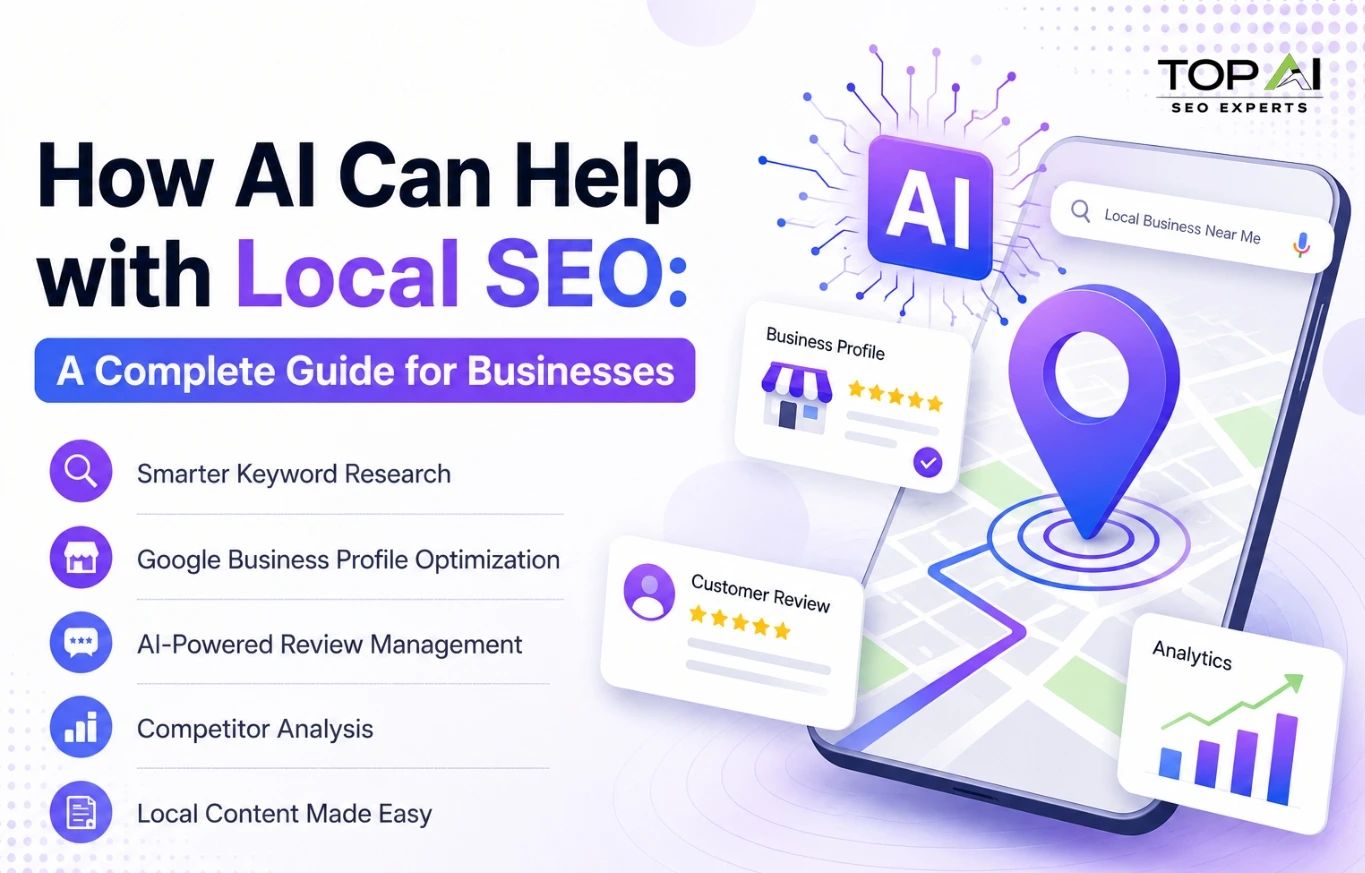
A quick correction up front: an earlier version of this page cited that "46% of all Google searches have local intent" and that complete Google Business Profiles get "7x more clicks," without a source we could stand behind. We've pulled both numbers rather than leave unverifiable stats on the page. What follows focuses on what AI tools actually do for local SEO and how to use them without creating a mess.
What AI actually changes for local search
AI doesn't replace the fundamentals of local SEO: an accurate Google Business Profile, consistent citations, real reviews, and locally relevant content still do the heavy lifting. What AI changes is how fast you can do the research and content work that supports those fundamentals, and in some cases, how customers find you in the first place, since more people now ask AI assistants and chat tools location-specific questions directly ("find a plumber open now near downtown Austin") rather than typing a search query.
Local keyword research, done properly
Instead of guessing at keywords, feed an AI tool a prompt describing your business, service area, and customer type, and ask it to generate the actual phrasing a local customer would use, including neighborhood names, nearby landmarks, and informal phrasing people use when they're in a hurry ("roofer near me open now" versus "roofing contractor services"). Then verify those terms against actual search volume in Google Keyword Planner or a tool like Semrush before building pages around them. The AI brainstorm is a starting point, not a final keyword list; it will generate plausible-sounding terms that don't actually get searched, and you'll waste time building pages for them if you skip the verification step.
A concrete example: a dentist in a mid-sized suburb might assume "dentist [city name]" is the main term to target, but local keyword research often turns up that "emergency dentist near [specific neighborhood or intersection]" or "[city] dentist that takes [specific insurance]" are the higher-intent, lower-competition terms actually worth building dedicated pages for.
Using AI to audit your Google Business Profile
Paste your current GBP description, your Q&A section, and a sample of your service descriptions into an AI tool and ask it to flag anything vague, outdated, or missing compared to your top three local competitors (which you'll need to look up and paste in separately, since the AI doesn't have live access to your actual competitors' listings). This catches things a busy owner misses: a service you added two years ago that's never been added to your GBP, categories that no longer match what you actually offer, or a business description that's generic enough to apply to any competitor in your category.
What AI can't do here: it can't post to your profile for you, verify your business, or respond to Google's occasional requests for additional verification. That part is still manual.
Want AI handling your local SEO the right way?
Get a free AI SEO audit and see exactly where your local visibility stands today.
Get My Free Audit →AI-assisted local content, with a human check every time
AI can draft a first pass of a neighborhood-specific service page, a seasonal post, or an FAQ answering common local questions, much faster than writing from scratch. The mistake businesses make is publishing that draft without a real review. AI-generated local content without a human pass tends to include generic phrasing that doesn't reflect how your business actually operates, occasional factual errors about your own services or area (it might describe a neighborhood inaccurately or invent a detail about your business it has no actual knowledge of), and a flat tone that doesn't sound like anyone who actually works there wrote it.
A workable process: use AI for the first draft and structural outline, then have someone who actually knows the business rewrite the specifics, add a real example or two from actual jobs, and cut anything that reads as filler.
Review management, smarter and faster
AI tools can help you draft personalized responses to reviews faster, flag reviews that mention a serious issue needing immediate follow-up (a complaint about a missed appointment or a safety concern, for instance) ahead of routine five-star reviews, and spot patterns across your reviews over time, like multiple mentions of long wait times, that point to an operational issue worth fixing rather than just responding to individually. It can't generate reviews for you, and it shouldn't; fabricated or incentivized reviews violate Google's policies and can get your profile suspended.
Competitor analysis that's actually useful
Rather than manually checking a handful of competitor websites, use an AI tool to summarize and compare competitor service pages, pricing pages (where public), and review themes you paste in. This speeds up the research, but the insight still has to come from you: noticing that three competitors all emphasize same-day service while you don't mention it anywhere on your site is the kind of gap that's easy to miss when you're buried in day-to-day operations, and easy to spot once the comparison is laid out clearly.
Citation consistency, checked at scale
Use a tool like Moz Local, BrightLocal, or even a careful AI-assisted manual check to compare your business name, address, and phone number across every directory you're listed on: Google Business Profile, Yelp, Apple Maps, Angi, industry-specific directories, your own website footer. Inconsistencies here (an old address, a dropped suite number, a different phone number from a forwarding service you stopped using) quietly undermine the trust signals that both traditional local search and AI-driven local answers rely on.
Voice and conversational search
As more local queries happen through voice assistants and AI chat tools, the content that gets surfaced tends to be the content that answers a specific question plainly: "are you open on Sundays," "do you offer free estimates," "how much does a typical service call cost." Make sure your FAQ pages and service pages actually contain direct answers to the questions your customers ask most often on the phone, since that's a good proxy for what they're asking AI tools and voice assistants too.
Common mistakes to avoid
Publishing AI-generated content without any human review or fact-check specific to your business. Treating an AI content calendar or keyword list as finished work rather than a draft that needs verification. Using AI to write reviews or review responses that misrepresent your business. And assuming AI tools have live, accurate information about your specific competitors or local market without you feeding them real, current data to work from, since these tools don't automatically know what's happening in your town this week.
The bottom line
AI is a genuinely useful accelerant for local SEO research and first drafts, not a replacement for the fundamentals or for someone who actually knows the business reviewing the output. Use it to move faster on keyword research, content drafts, and competitor comparisons, then check our guide on measuring whether it is actually working, and keep a human in the loop for anything that touches your actual Google Business Profile, your reviews, or claims about your own business.
Frequently asked questions
Keep exploring
Pair this with our local SEO guide for ranking higher on Google Maps. If you serve a specific trade, see how this applies to roofing businesses as one example. Ready to see where your own local visibility stands? Get a free AI SEO audit.