
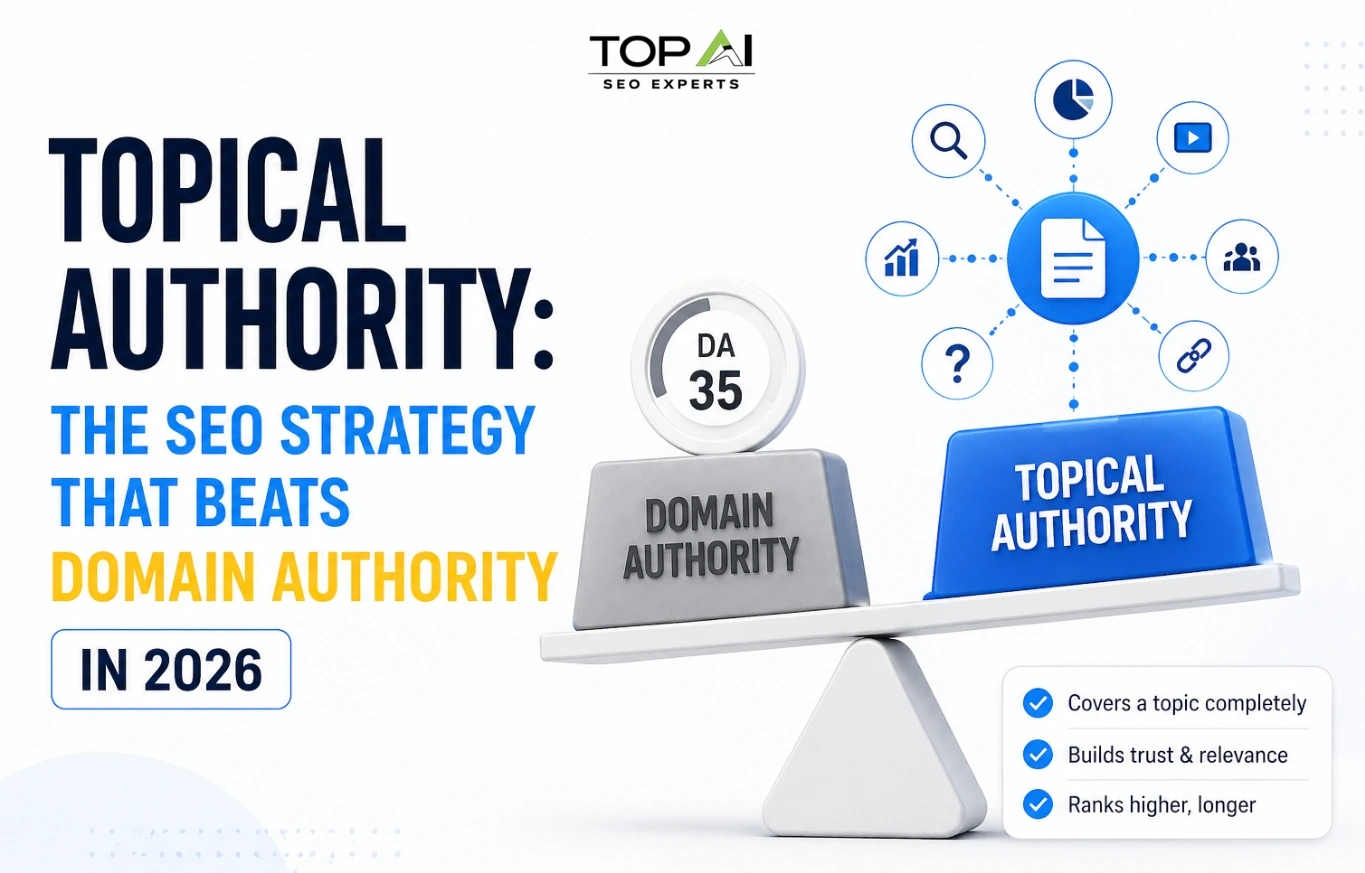
A new domain with six months of content can outrank a 10-year-old website with thousands of backlinks - if it owns the topic. This is topical authority at work, and in 2026 it has become the single most reliable predictor of sustained page-1 rankings, and the foundation of every effective AI SEO solution.
What Is Topical Authority?
Topical authority is the degree to which search engines recognise your website as the go-to expert on a specific subject. It is built not by a single outstanding article, but by comprehensively covering every meaningful subtopic within a domain - structured so that Google's crawlers can map your content as a coherent knowledge graph.
The concept formalises what Google has been doing algorithmically since the Hummingbird update in 2013 and accelerated with BERT, MUM, and the 2023 Helpful Content system: rewarding sites that demonstrate depth and breadth of coverage over sites that target isolated keywords.
"In 2026, SEO isn't about ranking pages. It's about owning topics."
Think of topical authority as the difference between a general-purpose blog with one article on email marketing versus a dedicated resource with 25 interconnected articles covering every angle - from subject line testing to deliverability, automation sequences, and re-engagement campaigns. The dedicated resource wins consistently, even if the general blog has more total backlinks.
Higher organic traffic for sites with structured content clusters vs. standalone pages after 12 months (DigitalApplied, 2026)
Average increase in organic traffic within 6 months after implementing pillar-and-cluster architecture (WebSpider Solutions, 2026)
Higher CTR when targeting micro-intents within a cluster vs. broad keyword targeting (Moz via XICTRON, 2026)
Topical Authority vs. Domain Authority: The 2026 Reality
Domain Authority (DA) was a reasonable proxy for ranking potential when backlinks were the dominant signal. In 2026, it remains useful as a benchmarking tool, but it is a poor predictor of rankings for specific queries. A high DA does not protect you from a niche specialist who has built topical depth you lack. This is precisely why modern AI SEO services focus on topical depth and structured content architecture rather than chasing raw link metrics.
| Factor | Domain Authority | Topical Authority |
|---|---|---|
| What it measures | Overall link profile strength across all topics | Depth & breadth of coverage on a specific subject |
| How it's built | Acquired through external backlinks over years | Built through structured content you control |
| Speed to impact | Slow - years of link acquisition required | Faster - meaningful gains in 3–6 months |
| Niche query predictor | Weak - high-DA generalists frequently outranked | Strong - topical depth maps directly to relevance |
| AI Overview citations | Low influence on citation selection | High - Google AI preferentially cites topical authorities |
| Under your control | Partially - depends on third-party behaviour | Yes - architecture and publishing cadence are yours |
For a complete breakdown of how these two strategies compare in practice, read our dedicated guide on AI SEO vs traditional SEO.
How Google Evaluates Topical Authority in 2026
Google does not have a single "topical authority score." It is an emergent property of how several systems assess your content simultaneously.
Entity recognition and knowledge graphs
Google's Knowledge Graph maps entities - people, places, concepts, organisations - and the relationships between them. When your content consistently and accurately covers the entities within a topic and links them semantically through your internal architecture, crawlers classify your site as an authority on that entity cluster. This is why semantic SEO and entity-based writing are foundational, not optional, in 2026.
E-E-A-T signals
Experience, Expertise, Authoritativeness, and Trustworthiness (E-E-A-T) are evaluated at both page and site level. Topical authority strengthens E-E-A-T by demonstrating you have covered a subject in its full complexity. Author credentials, original data, cited sources, and regularly updated content all reinforce these signals.
The Helpful Content system
Google's Helpful Content classifier - rolled into the core algorithm in 2024 - assesses whether content was created for humans or search engines. Thin, keyword-focused content is increasingly penalised. Sites with interconnected, comprehensive topical coverage are classified as people-first resources and rewarded accordingly.
Internal link equity and crawl efficiency
A well-structured topical architecture improves how Google crawls your site. When pillar pages link to cluster articles and cluster articles link back, PageRank flows efficiently through the structure. Orphaned pages - those with no internal links - rarely rank regardless of content quality.
Google AI Overviews
Google's AI Overviews preferentially cite sites that demonstrate comprehensive topical coverage. Being a recognised topical authority - particularly when your content strategy is guided by experienced AI SEO experts - increases your probability of appearing in AI-generated summaries, driving brand visibility even on zero-click queries.
How to Build Topical Authority: A 6-Step Framework
Choose One Core Topic (Your Pillar)
Resist building authority across multiple topics simultaneously. Pick the single subject most aligned with your commercial goals. Your pillar topic should be broad enough to support 10–25 subtopics but specific enough that you can be the best resource on the internet for it. For an SEO agency: "technical SEO" or "local SEO" works well. "Digital marketing" is too broad; "canonical tags" too narrow. If you're unsure which pillar to prioritise first, it's worth consulting with AI SEO experts who can map search demand directly to your commercial objectives.
Map Every Meaningful Subtopic (Cluster Pages)
Use Semrush, Ahrefs, or Google's "People Also Ask" to map every relevant subtopic, question, and search intent within your pillar. Break them into informational (how-to, what-is), commercial (comparisons, best-of), and transactional (pricing, hire) intents. Each subtopic becomes a cluster page - typically 1,000–2,500 words targeting one specific long-tail keyword.
Build Your Pillar Page First
Your pillar page is a 3,000–5,000-word comprehensive guide covering the topic at a high level and linking to every cluster article. It serves as the canonical authority hub. Thin pillar pages undermine the entire cluster's authority signal - address the topic's definition, core concepts, common questions, comparison of approaches, and clear next steps for every stage of the reader's journey.
Build Cluster Content Systematically
Publish cluster pages in priority order - starting where search demand is highest and competition is manageable. Each cluster page should target one specific keyword or micro-intent, link back to the pillar with contextual anchor text, and cross-link to other relevant cluster pages where appropriate. Quantity without structure fails - every piece must slot into the architecture.
Build a Deliberate Internal Linking Strategy
Internal linking is the connective tissue of your cluster. The hub-and-spoke model requires the pillar to link down to every cluster page, every cluster page to link up to the pillar, and cluster pages to cross-link to each other where contextually relevant. Aim for 3–8 contextual in-body links per article. Any important page with fewer than five internal links is at risk of underperforming regardless of content quality.
Refresh, Update, and Fill Gaps Continuously
Topical authority is not a campaign - it is a system. Update cluster content at least quarterly. Conduct a content gap analysis every six months: map your coverage against competitor clusters to identify missing subtopics. Pages that address gaps competitors haven't covered capture long-tail traffic and simultaneously strengthen your pillar's E-E-A-T signals. Authority compounds over 6–12 months, but only if maintained. See our client results to understand what sustained cluster publishing delivers in practice.
- Pillar page published (3,000–5,000 words, links to all cluster pages)
- Minimum 5 cluster pages published at launch
- Every cluster page links back to pillar with keyword-rich anchor text
- Bidirectional cross-links between related cluster pages
- FAQ schema markup added to pillar page
- All content updated with current year references and data
- Author bio with demonstrated expertise included
- Content gap analysis scheduled for 90 days post-launch
Want a custom topical authority roadmap for your site?
We'll map your pillar topics, cluster gaps, and 90-day content plan - free.
The Role of AI in Building Topical Authority Faster
AI has not changed what you need to do - it has changed how fast you can do it and how consistently you can execute at scale. The best AI SEO solutions combine machine-speed research with human-quality judgment, eliminating the mechanical labour that previously consumed most of a strategist's time and freeing them to focus on decisions that genuinely require expertise.
Keyword clustering and gap analysis at scale
Manually grouping a 5,000-keyword export by topic, intent, and funnel stage used to take days. AI clustering tools - integrated into Semrush, Ahrefs, and dedicated tools like Keyword Insights - complete this in minutes with greater consistency. The output is a prioritised content map that previously required two or three rounds of human review.
Content brief generation
AI can analyse the top-10 ranking articles for any cluster keyword and produce a structured brief identifying the subheadings, questions, and entities that should appear in a competitive piece. This reduces brief production time by 60–80% and ensures each cluster article is structurally competitive from the start.
Technical audit acceleration
AI-augmented technical audits surface high-priority issues - broken internal links, orphaned pages, crawl depth problems, missing schema - in hours rather than weeks. This matters because structural issues in your internal linking architecture can prevent cluster equity from flowing correctly, even when the underlying content is excellent.
How to Measure Topical Authority
Topical authority has no single dashboard score. It is measured through leading indicators that move before rankings improve, and lagging indicators that confirm the strategy is working. A Free AI SEO Audit is often the fastest way to establish these baselines and pinpoint exactly where your current architecture is leaking authority signals.
Leading indicators (0–3 months)
- Crawl coverage: Are all cluster pages being indexed? Rising indexed page count signals Google is accepting your topical architecture.
- Internal link depth: Do all important pages have 5+ unique internal links pointing to them? Track this monthly in Screaming Frog.
- Content gap closure rate: Aim for 60–70% subtopic coverage before expecting significant pillar ranking movement.
Lagging indicators (3–12 months)
- Cluster keyword rankings: Track average position for all cluster target keywords as a group, not individually.
- Pillar page ranking and traffic: Pillar pages build authority more gradually. Early long-tail wins on cluster pages are normal; pillar improvements follow.
- Share of Voice (SoV): The percentage of total available clicks for your topical keyword universe. SoV growing faster than competitors confirms topical authority is accumulating.
- AI Overview citations: Track whether your content appears in Google's AI-generated summaries for your core topic queries.
5 Common Topical Authority Mistakes to Avoid
- Publishing disconnected content without cluster architecture. Random blog posts do not accumulate topical authority - they compete with each other and dilute your signals. Every piece needs a structural home.
- Launching a pillar page with no cluster pages. A pillar without a cluster is just a long article. The authority signal comes from the interconnected system. Launch with at least 5 cluster pages simultaneously.
- Weak or missing internal linking. The most common structural failure. If cluster pages don't link back to the pillar, Google cannot identify the topical hub. Audit internal links after every content publish.
- Chasing too many topics simultaneously. Building authority across five pillar topics at once produces mediocre coverage everywhere. Complete one cluster before starting another.
- Ignoring content updates and decay. Cluster pages that become outdated drag down the entire cluster's freshness signals. Schedule quarterly updates as part of your editorial calendar.
Frequently Asked Questions
Ready to Build Topical Authority That Compounds?
Get a custom content cluster strategy for your site - including pillar selection, gap analysis, and a 90-day publishing roadmap.