
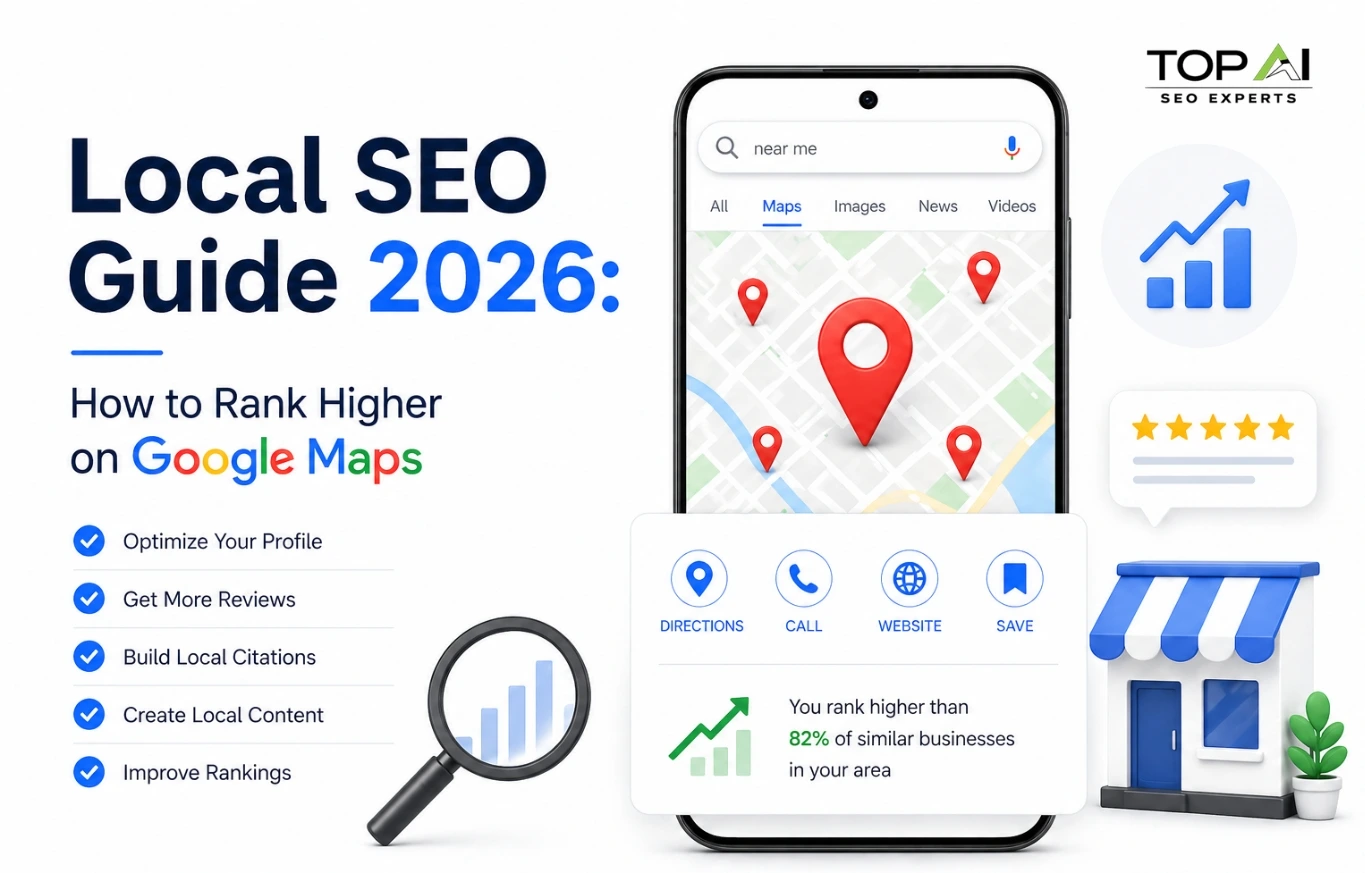
Most local SEO advice is two years out of date. This guide isn't. Every section is grounded in the Whitespark 2026 Local Search Ranking Factors report - the largest annual survey of local SEO practitioners - delivering the kind of rigorous AI SEO analysis that shows you exactly which levers to pull and which ones have stopped working.
of all Google searches have local intent (Think With Google)
of local searchers visit a business within 24 hours (Google, 2025)
top local ranking signals come directly from your GBP (Whitespark 2026)
How Google's Local Algorithm Works
Before optimising anything, you need to understand what you're optimising for. Google evaluates every local search across three primary signals:
| Signal | What It Measures | Your Control | Approx. Weight |
|---|---|---|---|
| Proximity | How close the business is to the searcher at query time | None | ~55% |
| Relevance | How well your GBP and website match the search query - driven primarily by your primary GBP category | High | ~32% |
| Prominence | How well-known and trusted the business is: reviews, citations, backlinks, brand mentions | High | ~16–20% |
One thing that surprises most business owners: your defined service area on your GBP does not influence your map pack ranking. A Whitespark 2024 controlled test confirmed this definitively. Google ranks you based on your verified physical address, not the coverage radius you draw on a map. Service area settings affect Maps navigation visibility - not local pack position.
Google Business Profile Optimization
Your Google Business Profile is the single highest-leverage asset in local SEO. According to Whitespark's 2026 survey, 8 of the top 10 local ranking signals come directly from the GBP itself. Roughly 11% of listings remain unclaimed - and an unclaimed profile means competitors can suggest edits that Google may accept without notifying you. Our client results consistently show that a fully optimised GBP is the fastest single route to local pack visibility.
Claim and Verify Your Listing
Go to business.google.com and claim your profile. Verification by postcard is still common for single locations; video verification is now available in most markets and significantly faster. Unverified profiles don't rank.
Choose the Right Primary Category
Your primary category is the most important relevance signal in your entire GBP. Pick the most specific category that accurately describes your core business - not the broadest one. A Thai restaurant should be "Thai Restaurant," not "Restaurant." Add secondary categories for additional services, but keep them accurate. Stuffing irrelevant categories can trigger a quality review.
Fill Out Every Field - Especially Services
The Services section is genuinely underused and directly affects relevance. Write individual service entries with descriptive names and short descriptions using the language your customers actually search. Complete your hours, phone, website, and all applicable business attributes.
Add Photos - and Keep Adding Them
Businesses with photos receive significantly more direction requests and website clicks. Upload real photos of your location, team, products, and completed work. Geotagged images add a small additional relevance signal. Aim for at least one new photo per week - freshness matters to Google's engagement signals.
Post Regularly
GBP Posts (updates, offers, events) generate engagement signals and show Google your listing is actively managed. A post with a specific offer - "15% off first appointment, book before May 31" - outperforms generic updates every time. One to two posts per week is the sweet spot.
Not sure where your GBP stands?
We check profile completeness, category accuracy, photo count, and review velocity - then tell you what to fix first.
Review Strategy & Velocity
Reviews account for 16–20% of local ranking weight, and that share has grown every year since 2021. It's the strongest controllable ranking factor after your GBP category. The key insight most businesses miss: it's not just your star rating. Google's algorithm weighs three distinct signals:
- Velocity: Consistently getting new reviews. A business with 40 reviews all from 18 months ago loses to a competitor with 20 reviews spread evenly across the past 6 months.
- Response rate: Businesses responding to 80%+ of reviews see measurable ranking improvements. Google treats owner responses as engagement signals.
- Total count: Still matters, but less than velocity. Don't sprint to collect 100 reviews then stop - the algorithm rewards ongoing consistency.
How to Get More Reviews Without Getting Penalised
The only safe approach is asking satisfied customers directly - in person, via email, or via SMS. Review gating (only sending requests to customers you know are happy) violates Google's policies, as does incentivising reviews.
The most effective method most businesses skip: ask immediately after a positive interaction, while the experience is fresh. A quick SMS with a direct link to your review page converts far better than an email sent three days later.
Responding to Negative Reviews
Google's algorithm doesn't specifically penalise individual 1-star reviews, but a low average rating reduces click-through rate on your listing - and click-through rate is a behavioral signal that does affect rankings. Respond professionally to all negative reviews and explain how you've addressed the issue. Potential customers read your responses as carefully as the reviews themselves.
NAP Consistency & Citations
NAP stands for Name, Address, Phone Number. Google cross-references your business information across directories to verify legitimacy. Inconsistencies - an old address on Yelp, a different number on YellowPages - create confusion signals.
Important 2026 context: NAP was more critical five years ago. Google has gotten significantly better at reconciling minor format variations. Think of it as defensive, not offensive. Fixing inconsistencies protects your rankings; it rarely creates them on its own anymore.
Where Citations Still Matter
The highest-value sources are core data aggregators that feed dozens of smaller directories: Localeze, Data Axle, and Foursquare. Fix your listing at the source and corrections propagate automatically. After that, prioritise industry-specific directories (Houzz for contractors, Healthgrades for medical, Avvo for legal) and directories with genuine traffic in your market.
On-Page Local SEO Signals
Your website amplifies your GBP. Google cross-references the two to validate relevance. On-page signals account for roughly 19% of local pack ranking weight - enough to be the deciding factor in competitive markets where GBP profiles are similarly optimised.
Location Pages
If you serve one location, ensure your homepage clearly states your city, neighbourhood, and service area in body text - not just in schema. Use the language your customers actually search. "Plumber in Austin" works. "Plumbing services serving the greater Austin metropolitan area" does not.
If you serve multiple locations, create a dedicated page per city or neighbourhood with genuinely distinct content, local testimonials, and location-specific imagery. Cloned doorway pages are a Google spam policy violation.
LocalBusiness Schema Markup
Add LocalBusiness schema to your homepage and location pages. At minimum include: name, address, telephone, openingHours, and geo coordinates. This helps Google connect your website to your GBP listing more confidently and can enable rich snippets. Use Google's Rich Results Test to verify it's error-free before deploying.
Page Speed & Mobile
Most local searches happen on mobile. Under 2.5 seconds on a mid-range Android is the baseline. Run Google PageSpeed Insights, fix the top 3 issues, and you'll capture 90% of available improvement. Image compression and eliminating render-blocking scripts are typically the biggest wins.
Local Backlinks
Links remain a prominence signal. For local SEO, AI SEO experts consistently find that geographic and topical relevance of the linking site matters far more than its raw authority score. A link from a local newspaper or business association beats a generic DR-50 national directory link every time.
Best Local Link Sources
- Local press coverage - pitch the story angle, not a link request
- Chamber of Commerce and local business association memberships
- Sponsoring local events, sports teams, or charitable organisations
- Guest posts on local blogs and community news sites
- Partnerships with complementary local businesses
- Getting listed on your city or county government's business resources page
- Hosting community events or workshops and getting listed in event directories
For a comprehensive breakdown of the most effective link acquisition techniques across all channels, read our full guide on link building in 2026.
Behavioral Signals
Google watches what people do after seeing your listing. A profile that gets clicked, called, and asked for directions consistently outranks one that gets ignored - even with better static signals. A Free AI SEO Audit is the fastest way to identify which behavioral signals your listing is currently underperforming on compared to your top local competitors.
The behavioral factors that correlate most strongly with map pack position: click-through rate, phone call clicks, direction requests, and website visits originating from your GBP.
Improving Behavioral Signals Legitimately
- Use higher-quality cover and thumbnail photos - these drive click-through rate directly
- Keep hours always accurate - incorrect hours destroy trust and reduce calls
- Use the GBP Q&A section to pre-answer questions about parking, pricing, and booking
- Add a clear CTA in your most recent GBP Post (book, call, get a quote)
- Answer Q&A questions yourself before searchers have to ask them
Losing clicks to competitors with weaker GBPs?
We audit your profile against your top 3 local competitors and show exactly where you're leaving customers on the table.
AI Overviews & What's New in 2026
Google's AI Overviews now appear above the local pack for many informational queries. For purely transactional local searches ("pizza near me," "emergency plumber Austin"), the 3-pack holds its position. But for research-intent queries ("best dentist for kids in Chicago"), AI Overviews are pulling traffic that previously flowed to the pack. Keeping up with AI SEO news is increasingly important - Google's AI-driven local features are evolving faster than any previous algorithm update cycle.
What This Means Practically
Your GBP optimisation work doesn't change - it becomes more important, because AI Overviews pull business data directly from GBP signals. But you also need to think about Answer Engine Optimisation (AEO): structuring your website content to answer the specific questions people ask before they've decided on a provider. Experienced AI SEO experts treat AEO and local SEO as a unified strategy rather than two separate workstreams. FAQ sections, clear service pages with natural Q&A structure, and consistent review language all contribute to appearing in AI-generated local summaries.
Quick-Start Local SEO Checklist
Work through this in order - items at the top have the highest impact-per-hour of effort invested.
- Claim and verify your Google Business Profile
- Set your primary GBP category (most specific accurate option available)
- Add all relevant secondary categories
- Complete every field: hours, phone, website, all applicable attributes
- Upload 10+ real photos - interior, exterior, team, products, work samples
- Add LocalBusiness schema to homepage and contact page
- Audit NAP consistency across Google, Yelp, Facebook, and Bing Places
- Fix listings at core data aggregators (Localeze, Data Axle)
- Claim your Apple Business Connect profile
- Set up a review request workflow (post-service SMS or email with direct link)
- Respond to every existing review - positive and negative
- Add location keywords naturally to homepage title tag, H1, and body text
- Create dedicated location/service pages if serving multiple areas
- Run Google PageSpeed Insights and fix top 3 issues
- Add an FAQ section answering common pre-purchase questions
- Populate GBP Services section with keyword-informed descriptions
- Publish 1–2 GBP posts per week (offers, updates, or events)
- Upload at least one new photo per week
- Respond to every new review within 48 hours
- Pursue one local backlink opportunity per month
- Track local pack rankings weekly with a dedicated rank tracker
Frequently Asked Questions
Ready to Dominate Your Local Market?
Free personalised audit of your GBP, citations, review profile, and on-page signals - with a prioritised action plan your team can execute in 30 days.