
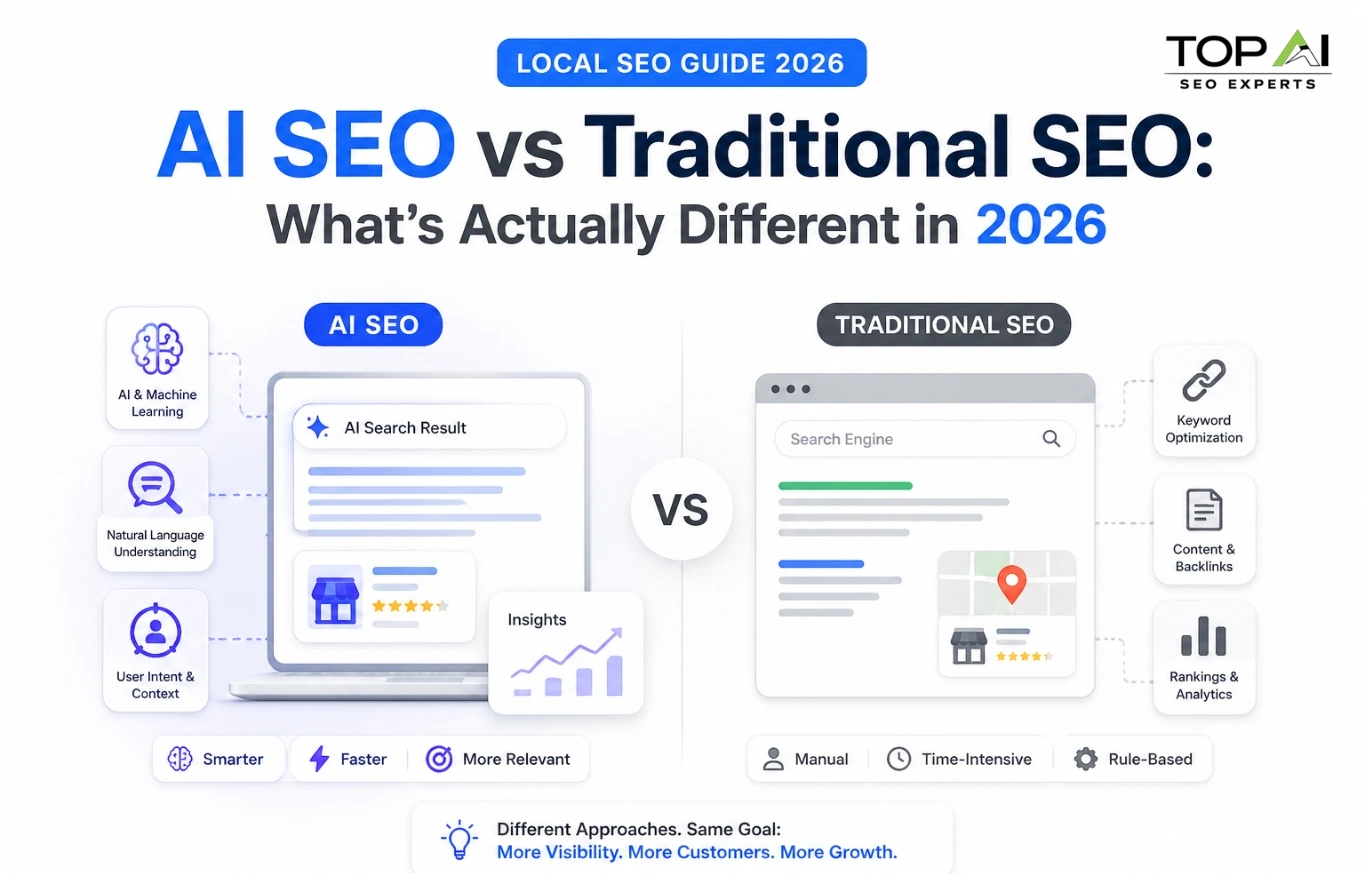
Traditional SEO optimises for a ranked list of blue links. AI SEO optimises for citation in a generated answer. Both matter in 2026. The problem is that most teams are still measuring one while the other quietly drives or destroys their visibility. This article explains the real differences and how to act on them - and how the right AI SEO services can position your brand for visibility across both channels simultaneously.
of all Google searches end without a click in 2026, driven by AI Overviews and featured snippets (Incremys, 2026)
higher conversion rate from AI-referred traffic compared to traditional organic search (PageOne Power, 2026)
of AI-powered search users say it is now their primary source of information, ahead of traditional search at 31% (McKinsey, Aug 2025)
The search landscape has not replaced traditional SEO. It has added a second layer on top of it. Total search usage, combining search engines and AI platforms, is up 26% globally since 2024. The pie is bigger. What has changed is which slice your content earns, and how you need to be structured to earn either one.
How the SERP Actually Changed
Three-quarters of SEO practitioners describe the same fundamental shift when asked what changed: the SERP used to be a list of options. In 2026, it is increasingly a resolved answer. Google AI Overviews appear on 25% of searches. ChatGPT reached 900 million weekly active users in February 2026. AI Mode is at 75 million daily users. These are not niche tools anymore - our SEO success stories consistently show that brands adapting to both channels early capture disproportionate visibility share.
The practical consequence is that the relationship between ranking and traffic has broken down for a growing share of queries. A page can rank position one and receive fewer clicks than it did in 2023 because an AI Overview resolved the query before the user clicked anywhere. For informational queries, AI Overviews currently appear 39.4% of the time. For navigational queries, that rate drops to 12%.
Traditional SEO vs AI SEO: Side by Side
| Factor | Traditional SEO | AI SEO (GEO) |
|---|---|---|
| Primary Goal | Rank in the top 10 for target keywords. Drive clicks through SERP position. | Be cited in AI-generated answers. Build brand authority that AI systems recognise and surface. |
| What You Optimise | Keyword placement, title tags, meta descriptions, on-page structure, backlinks, page speed. | Content structure (direct answers first), entity clarity, schema markup, brand mentions across the web, structured data. |
| How Queries Are Matched | Keyword matching and semantic relevance. Google reads your page and matches it to search queries. | Intent and entity understanding. AI systems parse your content to extract factual claims, not just match keywords. |
| E-E-A-T Signals | On-page signals: author bios, credentials pages, internal linking to expertise content. | Off-site validation: which authoritative publications cite your brand, third-party reviews, brand mentions. Branded web mentions correlate 0.664 with AI Overview appearances vs. 0.218 for backlinks. |
| Content Format | Long-form, keyword-rich. Depth and comprehensiveness signal expertise to crawlers. | Direct-answer format (BLUF). AI systems parse structured content, FAQ schema, tables, and definition lists more reliably than narrative paragraphs. |
| Success Metrics | Rankings, organic CTR, organic sessions, keyword visibility score. | Citation frequency in AI answers, AI referral traffic volume, brand mention share, share of AI Overviews triggered by target queries. |
| Link Building | Backlinks pass domain authority. Quantity and quality of inbound links directly correlate with rankings. | Brand mentions matter as much as links. Branded web mentions have 3x the correlation with AI visibility than backlinks alone. |
| Keyword Research | Volume-based. Target high-volume, low-competition keywords. Match search queries precisely. | Intent and entity-based. Identify the questions AI systems are answering and structure content to be the cited source for those answers. |
| Click Dependency | Every win requires a click. Rankings only generate value when someone visits the page. | Brand exposure without clicks. AI mentions influence brand trust and downstream purchase behaviour even when users do not visit your site. |
What Traditional SEO Still Does That AI SEO Cannot Replace
Before addressing what AI SEO adds, it is worth being precise about what traditional SEO still owns. The argument that AI SEO "replaces" traditional SEO misreads the data. Traditional search still drives the majority of web traffic. Only 0.1% of ChatGPT searches are transactional. For queries where someone is ready to buy, visit, or book, traditional SERPs still deliver most of the commercial value.
Where Traditional SEO Remains the Primary Channel
- Commercial and transactional queries: "Buy running shoes online," "emergency plumber Austin," "book a hotel in Paris" rarely trigger AI Overviews. Users with buying intent go to ranked results.
- Local search: The Google Maps local pack is not an AI-generated answer. Traditional local SEO (GBP optimisation, reviews, citations) still governs who appears in local results. This is one area where businesses see the fastest gains when they hire SEO experts with dedicated local specialisation.
- Navigational queries: When someone searches for a specific brand or website, AI features appear only 12% of the time. Traditional rankings dominate.
- Long-tail product queries: Specific product searches with buying intent retain high click-through rates because users need to see the actual page to complete the transaction.
- Technical foundation: Core Web Vitals, crawlability, HTTPS, and site architecture remain prerequisite signals for both traditional rankings and AI citation eligibility. A site that cannot be crawled is invisible to both systems.
5 Practical Differences That Change How You Work
Traditional search engines crawl and index the full text of your page, matching it to keyword queries based on relevance signals. AI systems do something different: they parse content into structured pieces through a process called chunking, extracting factual claims to use in generated answers. They do not read pages top to bottom the way a human does.
The practical implication is that content buried three paragraphs into a dense introduction may never be surfaced in an AI answer, even if the page ranks well traditionally. 44% of LLM citations come from the first 30% of a page's text. Leading with the direct answer (BLUF: Bottom Line Up Front) before expanding into supporting detail is the structural change that affects AI extraction most.
Write a comprehensive 2,000-word guide. Build to the conclusion. Keyword density and section depth signal expertise to crawlers.
State the answer in the first paragraph. Use H2/H3 structure, tables, and FAQ schema to make facts extractable. Support with depth below the fold.
Traditional SEO measures authority through backlinks. Domain Rating, Domain Authority, and similar metrics are proxies for the volume and quality of inbound links. These signals directly correlate with ranking position in traditional SERPs.
AI systems measure authority differently. Branded web mentions, meaning references to your brand name across the web without necessarily a hyperlink, have a correlation of 0.664 with AI Overview appearances. Backlinks have a correlation of only 0.218 with the same metric. This means a brand consistently cited in news articles, forums, and industry discussions will appear in AI answers more often than a technically stronger domain with fewer brand mentions.
Build backlinks through guest posting, digital PR, and broken link building. Improve domain authority metrics.
Generate brand mentions across authoritative sources. Run digital PR for coverage, not just links. Monitor unlinked brand mentions.
In traditional SEO, schema markup enables rich results: star ratings, FAQ dropdowns, and breadcrumbs in the SERP. These improve click-through rate but are not direct ranking factors. Many sites implement schema for CTR gains and stop there.
For AI systems, structured data is a parsing shortcut. JSON-LD schema on FAQ sections, HowTo guides, and Article pages explicitly tells AI systems what each piece of content answers and how it is organised. Sites with comprehensive, error-free schema are architecturally positioned to be cited in AI-generated responses regardless of their traditional ranking position. 40% of AI Overview citations now come from pages that do not rank in the traditional top 10, and structured data is one of the key reasons a lower-ranking page gets cited over a higher-ranking one.
Implement schema for rich result eligibility. Product, LocalBusiness, and Breadcrumb schema for SERP enhancements.
Add FAQPage, HowTo, and Article schema to every relevant page. Lead with direct answers. Make every factual claim extractable without context.
Traditional SEO success is straightforward to measure. Rankings, organic sessions, and CTR are tracked in Google Search Console and analytics platforms. A position improvement is visible within days of a Googlebot crawl.
AI SEO success is harder to measure because the primary value, brand citation in an AI-generated answer, does not always produce a click. Only 1% of users click sources cited within AI Overviews. The brand exposure still influences trust and downstream behaviour, but it does not show up in Google Analytics session counts. Measuring AI SEO requires tracking citation frequency directly, monitoring AI referral traffic as a separate channel, and tracking branded search volume as a downstream indicator of AI-driven awareness.
Traditional SEO targets Google, Bing, and the handful of other search engines with meaningful market share. Google holds 89.9% of global search market share in 2026, so optimising for Google effectively means optimising for traditional search.
AI SEO spreads across a larger platform landscape. ChatGPT leads AI referral traffic with 55 to 60% share. Perplexity holds 18 to 22%. Gemini accounts for approximately 8.65% of AI chatbot referral traffic. Critically, AI Overviews and AI Mode cite different source pools, with only 13.7% overlap between them. Optimising for one AI surface does not automatically optimise for another. A consistent cross-platform strategy, built on well-structured content and clear entity signals, is the only approach that scales.
Optimise for Google. Secondary consideration for Bing. Single-platform focus justified by market share concentration.
Optimise content structure for cross-platform AI citation. Google AI Overviews, AI Mode, ChatGPT, and Perplexity all pull from different sources.
Not sure how your site performs on AI search surfaces?
We audit your AI Overview citation rate, structured data coverage, and brand mention profile in one report.
How to Split Your SEO Budget in 2026
The data supports a clear allocation for most businesses. Traditional SEO still delivers the majority of commercial traffic, so it remains the primary budget allocation. AI SEO is the growth layer that captures an increasingly important segment of visibility, particularly for informational and research-intent queries that precede purchase decisions.
Technical SEO, on-page optimisation, link building, Core Web Vitals, local SEO, keyword research, and content production for ranked pages.
Structured data expansion, content restructuring for BLUF format, digital PR for brand mentions, FAQ schema, and AI citation monitoring.
This split adjusts based on your query mix. If your site primarily targets commercial and transactional queries, lean more heavily toward traditional SEO. If you rely on informational and educational content that feeds a longer purchase cycle, invest more in AI SEO where Overviews appear most frequently. For businesses operating across multiple regions, working with an international SEO company ensures the allocation accounts for regional differences in AI Overview frequency and search behaviour across markets.
New Metrics to Track Alongside Traditional KPIs
- Organic ranking positions by keyword
- Organic click-through rate from Search Console
- Organic sessions by landing page
- Core Web Vitals field data (LCP, INP, CLS)
- Domain authority and backlink profile growth
- Crawl coverage and index status
- AI Overview appearance rate for target queries
- AI referral traffic (ChatGPT, Perplexity, Gemini as separate channels)
- Branded search volume as a downstream AI awareness signal
- Brand mention frequency across authoritative sites
- Citation frequency in AI Mode vs AI Overviews separately
- Rich result impression share from structured data
What to Do This Quarter
Rather than starting from scratch, the most efficient path is to upgrade existing content for AI visibility while maintaining the traditional SEO foundations already in place.
- Audit your top 20 traffic pages for BLUF structure. Move the direct answer to the first paragraph on any page where it is currently buried in context or introduction.
- Add FAQPage schema to every page that answers common questions. This is the single highest-impact structured data addition for AI Overview eligibility.
- Build a structured content cluster around your primary topic. A well-executed topical authority SEO strategy improves both traditional rankings and AI citation frequency simultaneously - it is one of the highest-leverage investments in your content architecture.
- Set up brand monitoring using Google Alerts or Ahrefs Content Explorer. Identify unlinked brand mentions and track citation frequency across AI platforms monthly.
- Check your robots.txt for any rules that might be blocking AI crawlers like GPTBot, Claude-Web, or PerplexityBot. If you want AI citations, those crawlers need access.
- Start tracking AI referral traffic as a separate channel in your analytics. In Google Analytics 4, create a custom channel group for traffic sourced from ChatGPT, Perplexity, and similar domains.
- Run your top pages through Google's Rich Results Test and fix any schema errors. Invalid schema is one of the primary reasons well-structured pages are not cited in AI Overviews.
- Identify which of your target queries now trigger AI Overviews by manually checking them in a logged-out Google session. If you are unsure how to interpret the results, book a free SEO consultation to get expert guidance on which queries need BLUF-formatted, schema-marked content to compete for citation.
Frequently Asked Questions
Want Visibility in Both Traditional and AI Search?
We audit your content for AI citation readiness, structured data coverage, and brand mention profile, and build a strategy that works across both channels.