
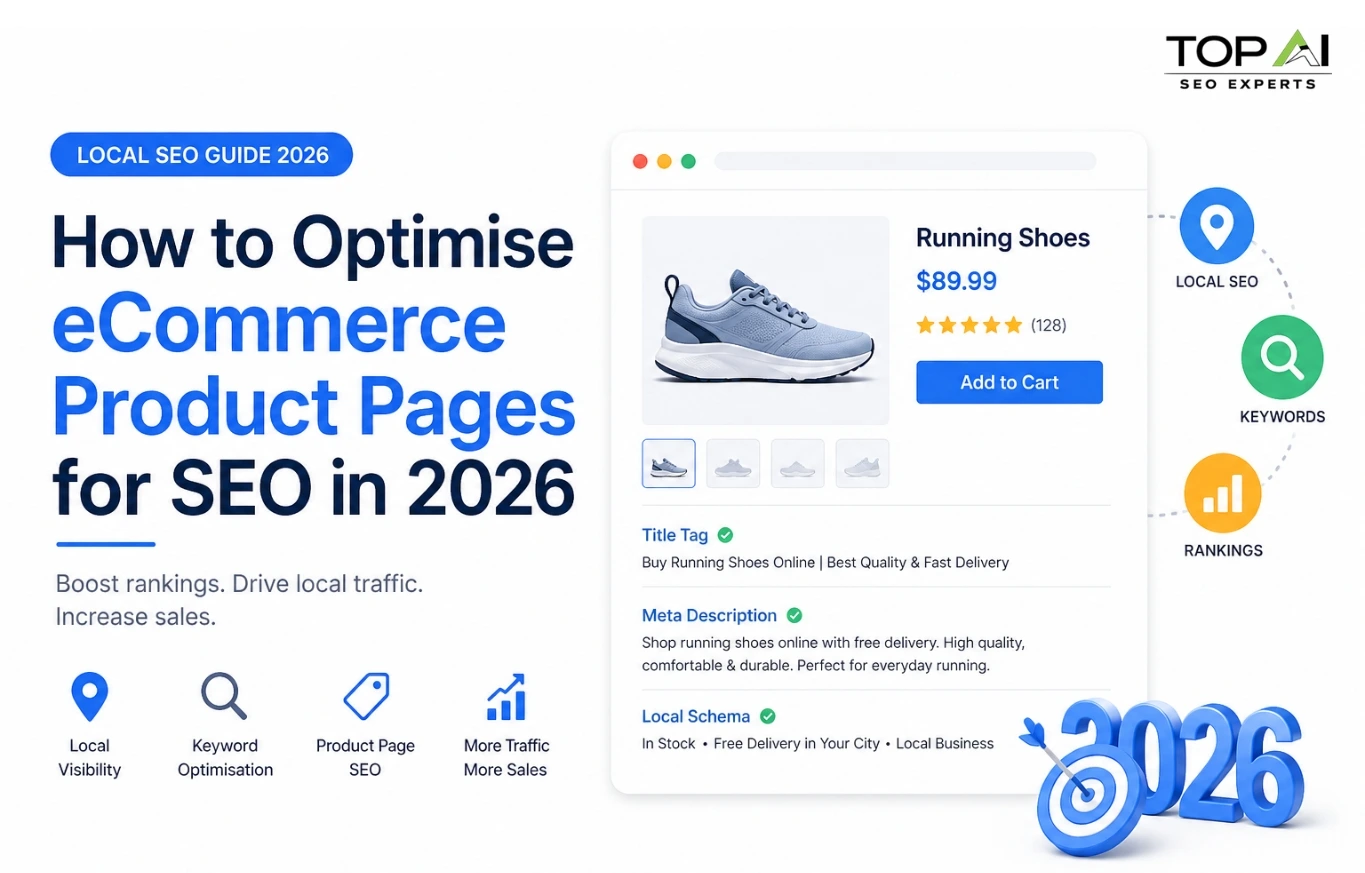
Product pages are where ecommerce revenue is won or lost in search. Get them right and organic traffic converts. Get them wrong and even a strong domain bleeds clicks to competitors with weaker sites but better-optimised PDPs. This guide covers every lever that moves product page rankings in 2026.
of all ecommerce orders come from organic search (SeoProfy, 2026)
conversion increase for product pages displaying customer reviews (Taylor Scher SEO)
of lowest-ranking ecommerce sites have thin content problems (Reboot Online)
Title Tags and Meta Descriptions
Your title tag is the single highest-impact on-page element for product pages. It tells Google what the page is about and it determines whether a searcher clicks. Most ecommerce sites get both wrong in the same way: they pull the product name verbatim from the database and call it done.
Title Tag Formula for Product Pages
The most effective structure for transactional product pages is: Primary Keyword + Brand or Model + Key Differentiator | Site Name. For example: "Men's Trail Running Shoes - Brooks Ghost 16 - Waterproof | RunnerHQ" outperforms "Brooks Ghost 16" as a title because it matches more query variations and signals relevance faster.
- Keep titles between 55 and 65 characters to avoid truncation in SERPs
- Lead with the keyword the page targets, not the brand name
- Include one specific differentiator (color, size range, material, use case)
- Avoid duplicate title tags across variant pages (size, color) by using canonical tags instead
Meta Descriptions That Drive Clicks
Meta descriptions do not directly influence rankings. They influence click-through rate, which does. A meta description that restates the product name adds nothing. One that answers the searcher's unspoken question ("Is this in stock? Will it fit my use case?") increases CTR meaningfully.
Write 150 to 160 characters. Include the primary keyword once, a specific benefit, and a low-friction CTA. "Free shipping over $50. Waterproof trail runners with 12mm drop for technical terrain. Available in sizes 7-15. Ships same day." converts better than "Shop the Brooks Ghost 16 at RunnerHQ."
Product Descriptions That Rank and Convert
Thin product descriptions are the most common technical content problem on ecommerce sites, found on 92% of lowest-performing sites. Copying manufacturer descriptions is the fastest way to create duplicate content issues across dozens of competing retailers.
Write Unique Descriptions for Every SKU
No shared descriptions across variants. No lifted manufacturer copy. Google treats your product page as thin content when the description matches text found on 10 other retailer sites. Write from the customer's perspective: what problem does this solve? What does it feel like to use? What do buyers consistently ask before purchasing?
Use Keyword-Rich Subheadings Inside Descriptions
Long-form descriptions (300 words or more) benefit from H3 subheadings that target secondary keyword variations. "Who This Shoe Is For", "Technical Specs", and "What Customers Say" are natural subheadings that capture additional query variants without keyword stuffing.
Lead With Benefits, Follow With Specs
Most descriptions lead with specs. Specs are necessary but they do not answer the question a searcher is actually asking. Lead with the primary benefit (what it does for the buyer), then support it with specs. This structure also performs better in AI Overview excerpts, where Google surfaces the most direct answer to the implied query.
Add a Size or Fit Guide on Apparel and Footwear Pages
Size and fit questions drive a significant share of pre-purchase searches. A brief size guide embedded on the product page targets these queries, reduces return rates, and increases time on page. All three improve your page's performance signals.
Product Schema and Structured Data
Product schema markup tells Google exactly what your page contains without forcing it to infer from surrounding text. It enables rich results in SERPs: star ratings, price, availability, and shipping information displayed directly in the listing. Rich results consistently achieve higher click-through rates than standard blue links for product queries.
Required Schema Fields for Every Product Page
| Schema Property | What It Does | Priority |
|---|---|---|
name |
Product name as it appears on the page | Required |
description |
Plain text product description, no HTML | Required |
image |
High-res product image URL (minimum 1200px wide) | Required |
offers (price, currency, availability) |
Enables price and stock status in rich results | Required |
aggregateRating |
Displays star ratings in SERP snippet | High impact |
brand |
Helps Google match branded queries to your page | Recommended |
sku / gtin |
Ties listing to Google Shopping and Merchant Center | Recommended |
review |
Individual review content, supplements aggregateRating | Optional |
Google Merchant Center and Shopping Integration
A clean, well-maintained product feed in Google Merchant Center unlocks Shopping results, free product listings, and richer SERP surfaces that standard keyword SEO cannot access. Product schema on your pages and an accurate Merchant Center feed reinforce each other. Discrepancies between the two (price, availability, title) can trigger policy violations and suppress your listings.
Not sure if your product schema is valid?
We audit your schema markup, rich result eligibility, and Merchant Center feed for errors in one pass.
Core Web Vitals and Page Speed
Google uses Core Web Vitals as a page experience signal. For ecommerce, the stakes are higher than for content sites: slow product pages lose both rankings and conversions at the same time. Speed is a conversion factor, not just an SEO factor.
| Metric | Target | What It Measures | Biggest Ecommerce Culprits |
|---|---|---|---|
| LCP (Largest Contentful Paint) | Under 2.5s | How fast the main product image loads | Unoptimised hero images, slow hosting, no CDN |
| INP (Interaction to Next Paint) | Under 200ms | How quickly the page responds to clicks (add to cart, image zoom) | Heavy JavaScript, third-party scripts, chat widgets |
| CLS (Cumulative Layout Shift) | Under 0.1 | How much the page jumps around while loading | Images without dimensions, late-loading ads, font swaps |
Run your top 20 product pages through Google PageSpeed Insights and CrUX data. Fix issues by page type, not individually. If your product page template has an unoptimised hero image slot, fixing it on the template fixes it across your entire catalog.
Image Optimisation for Product Pages
Product images are a major source of both performance problems and ranking opportunities. Most ecommerce platforms serve images at full upload resolution by default. A 4MB JPEG of a shoe has no business on a product page.
Image SEO Checklist
- Compress all product images to WebP or AVIF format (typically 60 to 80% smaller than JPEG with no visible quality loss)
- Set explicit
widthandheightattributes on every image element to prevent CLS - Write descriptive alt text: "Navy blue men's waterproof trail running shoe, side view" not "product image 1"
- Name image files with keywords before upload:
brooks-ghost-16-mens-trail-shoe-navy.webpnotIMG_4921.jpg - Use
loading="lazy"on all images below the fold andfetchpriority="high"on the hero product image - Submit an image sitemap to Google Search Console for large catalogs
- Include multiple angles, lifestyle shots, and a scale reference image. Google Images drives meaningful product discovery traffic.
User-Generated Content: Reviews and Q&A
Reviews do three things for product page SEO. They add fresh, keyword-rich content to the page without you writing it. They generate the social proof signals that increase conversion rates. And through aggregateRating schema, they enable star ratings in your SERP snippet, which increases click-through rate even before a visitor reaches your page.
Sites displaying reviews see conversion increases of up to 270%. From an SEO standpoint, the volume of unique text added by reviews directly counters the thin content issue that holds back most product pages.
Getting More Reviews
- Send a post-purchase review request email 7 to 14 days after delivery, not immediately after order
- Include a direct link to the review form in the email (every extra click kills conversion)
- Ask a specific question: "How did the fit compare to your expectations?" gets more useful responses than "Leave a review"
- Display a review count prominently on the page, even if it is low. "3 reviews" is better than no count
- Respond to negative reviews. Responses add unique text to the page and demonstrate trust to both users and Google
Product Q&A Sections
A Q&A section on a product page targets the long-tail questions buyers search before committing. "Does this tent work in snow?" and "What size should I order if I am between sizes?" are real search queries. Answering them on the page captures that traffic and reduces pre-purchase support load simultaneously.
URL Structure and Internal Linking
Clean, stable URL slugs are foundational for ecommerce SEO. They are also the most frequently botched element of platform migrations.
Product Page URL Best Practices
- Keep URLs short and descriptive:
/shoes/mens-trail/brooks-ghost-16beats/product/category/12847?sku=BG16M - Use hyphens as word separators, never underscores or spaces
- Include the primary keyword in the URL slug, not just the product ID
- Keep URLs lowercase and stable. Changing a URL after a page has earned backlinks loses that link equity unless 301 redirects are in place
- Canonicalise variant pages (different sizes, colors) to the main product URL to avoid duplicate content
Category Pages Outrank Product Pages for Head Terms
A key insight most ecommerce teams miss: category and collection pages rank for broader head-term queries more often than individual PDPs. "Trail running shoes" as a search query returns category pages from major retailers, not individual product pages. Your PDPs should target the long-tail: "Brooks Ghost 16 mens waterproof size 11." Your category page targets the head term.
Internal links from category pages to PDPs pass equity down the hierarchy and reinforce the topical relationship between them. Every product page should receive at least one contextual internal link from its parent category page.
Duplicate Content and Faceted Navigation
Faceted navigation (filter URLs created when shoppers sort or filter by size, colour, price range) is the single biggest source of duplicate content and index bloat on ecommerce sites. A catalog of 5,000 products can generate 50,000 crawlable filter URL combinations, most of which are near-identical to existing category or product pages.
Managing Faceted Navigation
- Add
noindexto filter combination URLs that create near-duplicate pages (e.g.?color=blue&size=M) - Use canonical tags on paginated category pages to point back to page 1
- Allow Google to crawl variant filter URLs that target real keyword demand (e.g. "waterproof hiking boots" may warrant its own indexed URL)
- Disallow internal search result pages in
robots.txt(/search?q=) - Disallow cart, checkout, wishlist, and account pages in
robots.txt - Handle discontinued products with a 301 to the nearest replacement, not a soft 404 or redirect to the homepage
Is faceted navigation killing your crawl budget?
We map your indexable URL landscape and identify duplicate content clusters across your full catalog.
AI Overviews and What Changes in 2026
16% of ecommerce searches now display an AI Overview. For product-specific queries, this share is still relatively low (only 0.3% of AI Overviews currently include ecommerce sources). The more immediate impact is on informational queries that precede a product purchase: "best trail running shoes for wide feet" or "how to choose a standing desk." These informational pages now compete for AI Overview placement before the buyer reaches a product page.
How AI Overviews Affect Product Page Traffic
AI Overviews cause a 61% CTR decline for organic results on affected queries. If your top-of-funnel content pages target queries that now trigger AI Overviews, your traffic from those pages will have dropped regardless of ranking position. The fix is to optimise those pages for AI Overview citation rather than trying to outrank the AI summary.
Being cited in an AI Overview earns 35% more organic clicks and 91% more paid clicks than ranking organically in the same position without citation. The playbook for citation: structure your content in direct Q&A format, use specific and verifiable data points, and ensure your schema markup is complete so Google can extract your content accurately.
Product Page SEO Checklist
Work through this by priority. Items in the first group have the highest impact per page. Items in the later groups compound over time.
- Unique title tag with primary keyword leading (55 to 65 characters)
- Unique meta description with keyword, benefit, and CTA (150 to 160 characters)
- Unique product description written from the buyer's perspective (300 words minimum)
- H1 tag contains the primary keyword and matches the page's target query
- Primary keyword appears in the URL slug
- Breadcrumb navigation present and linked correctly
- Product schema with name, description, image, and offers (price, currency, availability)
- aggregateRating schema tied to real on-page reviews
- Schema validated with Google's Rich Results Test (zero errors)
- Product feed synced and clean in Google Merchant Center
- GTIN or SKU included in schema for Shopping integration
- Hero image in WebP or AVIF format, under 150KB
- All images have explicit width and height attributes
- All images have descriptive alt text with keyword where natural
- Hero image uses fetchpriority="high", below-fold images use loading="lazy"
- LCP under 2.5s and INP under 200ms on mobile (verify in PageSpeed Insights)
- Canonical tag on variant pages pointing to the primary product URL
- Filter and facet URLs managed with noindex or canonicals
- Cart, checkout, and account pages disallowed in robots.txt
- Internal search pages (
/search?q=) noindexed - Discontinued products redirected to nearest live replacement (301)
- All product pages return 200 OK status (not 302 or soft 404)
- Post-purchase review request sequence active (7 to 14 days post-delivery)
- Q&A section present on high-traffic product pages
- Each product page linked from its parent category page
- Related product recommendations use descriptive anchor text, not "You may also like"
Frequently Asked Questions
Ready to Grow Organic Revenue From Your Product Pages?
Free audit of your top 20 PDPs covering on-page, schema, Core Web Vitals, and duplicate content issues, with a prioritised fix list.