
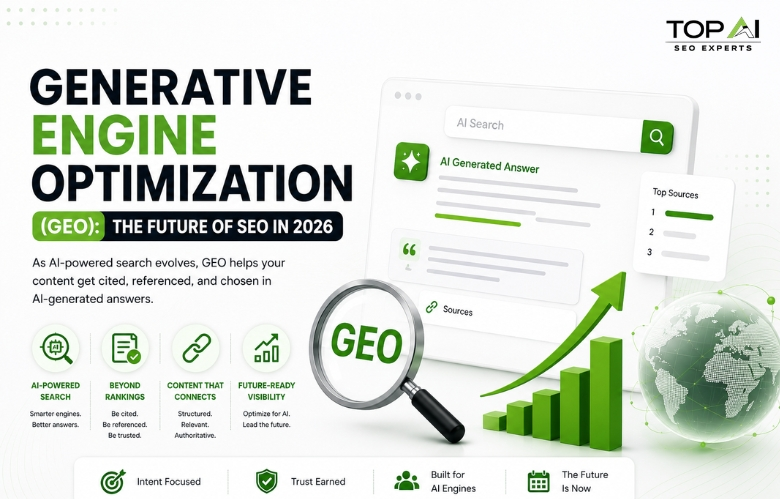
Type a question into ChatGPT, Perplexity, or Google's AI Overviews and you get an answer, not a page of blue links. Somewhere in that answer, a handful of sources get named or linked. Generative Engine Optimization (GEO) is the practice of making sure your content is one of the sources the model picks, instead of one of the thousands it skips.
That sounds like a small shift from traditional SEO. It isn't. The mechanics of how a result gets chosen are different enough that a site built purely for Google's ranking algorithm can rank well there and still be invisible inside an AI answer.
How traditional search and AI search actually differ
Traditional SEO optimizes for a ranking problem: given a query, order a list of pages by relevance and authority, and show the best ones. The searcher does the reading. Your job is to earn a high position and a compelling snippet so they click through.
AI search optimizes for a synthesis problem. The model has already read (or been trained on, or retrieved) a set of possible sources, and it needs to compress them into a short, coherent answer. It doesn't need to show you ten options. It needs one version of the truth, assembled from whichever sources gave it the clearest, most quotable material. Clicking through becomes optional for the user, which is exactly why getting cited as the source matters more here than ranking at position three.
This changes what "optimization" means in practice:
- A page can rank on page one of Google through strong backlinks and domain authority, and still never get pulled into an AI Overview if its actual content is vague or buried under narrative.
- A smaller site with a precise, well-structured answer to a specific question can get cited by an AI tool even with a fraction of the backlink profile a competitor has.
- Backlinks still matter for traditional rankings, but for AI citation, the model cares more about whether your sentence actually answers the question than about who links to you.
How AI models actually select and cite sources
Large language models used for search, whether that's a retrieval-augmented system like Perplexity or Google's AI Overviews, or a model answering from a mix of training data and live retrieval, tend to favor content with a specific set of traits. None of this is mysterious or proprietary; it follows directly from how these systems are built.
Extractable answers. Models are built to pull a clean, self-contained statement and drop it into an answer with minimal rewriting. A paragraph that opens with "Generative Engine Optimization is..." and gives a direct, complete definition in the first sentence is far easier to lift than three paragraphs of scene-setting before you get to the point. If a human has to read your whole section to figure out what you're actually claiming, a retrieval system will probably skip past it too.
Specificity over assertion. "Our clients see better rankings" is not useful to a model trying to answer "does GEO work." A sentence with a mechanism, a number, or a named example is. If you write "schema markup on FAQ pages reduced our average time to first citation in Perplexity tests by making the question and answer pairs easier to parse," that's something a model can actually use, because it's a specific claim tied to a specific cause. A sentence that just asserts a benefit with no supporting detail gives the model nothing to extract.
Structural clarity. Headings that match the actual questions people ask, short paragraphs, and lists that are properly nested (not "fake" lists built from bolded text with no actual list markup) make it dramatically easier for a crawler or retrieval pipeline to parse your page into discrete, answerable chunks. A wall of text with no structure forces the model to guess where one idea ends and another begins, and models are conservative about citing things they had to guess at.
Consistency across the web. If your brand or your claim about a topic appears the same way across your own site, a few guest contributions, and some third-party mentions, that consistency functions as a kind of corroboration. If you say one thing on your homepage and contradict it in a blog post, a model that pulls from both is less likely to trust either.
Freshness signals that are real, not cosmetic. A "last updated" date with no actual content change doesn't fool anything. What helps is content that's been genuinely revised when the underlying facts changed; a pricing page updated the month prices changed, a statistics roundup updated when the source data refreshed. Models retrieving current information weight recency, but only recency tied to substance.
What this means for your content, concretely
Write the actual question as a heading, not a clever variant of it. If people are typing "how does AI decide which page to cite," your H2 should say roughly that, not "The Citation Conundrum."
Answer in the first one to two sentences after the heading. Save the nuance, caveats, and examples for after the direct answer, not before it.
Use real numbers and named examples wherever you have them. If you don't have real data, say so, or don't make the claim. A vague claim is worse than an honest "we don't have published data on this yet."
Mark up lists and FAQs as actual HTML lists and FAQ schema, not bolded paragraph fragments styled to look like a list. This is also, not coincidentally, a basic accessibility and semantic HTML practice that's been good hygiene for over a decade. GEO didn't invent the idea that search engines and screen readers alike prefer real markup over visual tricks. It just raised the stakes.
Build genuine mentions elsewhere, through interviews, guest contributions on sites with real editorial standards, or being quoted by someone else covering your space. This is slower than buying links ever was, and there's no shortcut around it. It's also one of the few GEO tactics that's hard to fake, which is exactly why it carries weight.
Is your content built for AI search yet?
Get a free AI SEO audit and find out if your pages are structured to earn citations in ChatGPT, Gemini, and AI Overviews.
Get My Free Audit →Where GEO and SEO overlap, and where they don't
Most of the work that makes a page good for GEO also makes it good for regular SEO: clear structure, genuine expertise, real examples, content that answers the actual question instead of circling it. If you're doing solid SEO already, you're most of the way to being GEO-ready.
The gap shows up in a few specific places. Traditional SEO will reward a long, comprehensive page that covers a topic from every angle, because comprehensiveness used to correlate with ranking well. GEO doesn't care how comprehensive your page is as a whole; it cares whether any single passage in that page is a clean, extractable answer to the specific question being asked. A 4,000-word page where every paragraph buries its point works fine for a human willing to skim, and poorly for a model deciding what to quote.
The other gap is measurement, which we cover in our guide to measuring AI SEO success. Rank tracking tools are mature and reliable for Google. Measuring whether you're being cited inside AI answers is still a patchwork of manual spot checks, a handful of newer tracking tools, and watching your referral traffic from AI platforms in analytics. Anyone who tells you they have a precise, comprehensive way to measure AI citation share across every model is overstating what currently exists. Treat GEO progress as directional for now, not as a clean dashboard metric.
None of this means abandon your existing SEO work. It means add a second lens: for every important page, ask not just "will this rank" but "if a model read this paragraph by itself, out of context, would it actually be able to answer the question with it." That second question is the whole discipline, and it's more about writing clearly than about any new technical trick.
Frequently asked questions
Keep exploring
See how this connects to what LLM SEO is and how to rank in Google AI Overviews. For the difference between old and new approaches, read AI SEO vs traditional SEO. Want a plan built around your site specifically? Book a free consultation.